By Aisha Nankya
Posted Thursday, July 1 2010 at 00:00
Former Buganda premier Joseph Mulwanyamuli and some former kingdom ministers have formed a political mobilisation group called Suubi 2011 to support what they termed a ‘highly desired change in next year’s general elections’. Democratic Party MPs Erias Lukwago (Kampala Central), Betty Nambooze(Mukono north) and Dr Lulume Bayiga (Buikwe South) who are opposed to Norbert Mao’s leadership in DP have now joined hands with Ssegona Lubega and Mathias Mpuuga to form the group. The group, according to its coordinator Sseggona, will partner with all bona fide and legitimate forces of change.
They also said they would identify candidates for every electoral position but in the meantime, will engage with the Inter-Party Cooperation to identify areas of common interest. For starters, some members of this group are the same people who made all efforts but in vain to frustrate the renewal of DP leadership.
After being defeated in both Mbale and court, these people started panicking by scheming to deny Mao the Buganda votes which they claim to be in charge. The first move was to involve the two ex-Katikkiro’s who announced their support for Col. Kizza Besigye under IPC. They also sought to invoke the powers of the Kabaka to excite the Baganda into voting for IPC who will likely be led by Besigye. Little did they know that the Baganda will judge them more on their record during their service at Mengo. Mulwanyamuli is for instance already battling with explaining why he had settled for Regional Tier yet Buganda wanted federo. How different is he from Besweri Mulondo?
If this group was genuine, why have they left out other Mengo ex-ministers like NRM’s George Nsamba Kumama, Abdul Nadduli and independent JC Muyingo? How different is their group from Beti Kamya’s Uganda Federal Alliance and where does this leave her? What is annoying is that these people claim to be sacrificing for Buganda yet in the actual sense they are looking for jobs in Parliament. How much of their parliamentary salary have they offered to Mengo despite having gained entry by riding on Mengo’s back? Where do they get the mandate to speak for Buganda?
This group looks at the Baganda as passive participants in the 2011 elections which is reminiscent of the infamous Kabaka Yekka (KY) of 1962. They purport to think for the entire region and are in effect in fear of the people’s verdict. Serving at Mengo is not a guarantee that you love Buganda more but if they meant to sacrifice, they wouldn’t seek for higher pay in Parliament and leave the voluntary service at Mengo. In the spirit of building democracy as opposed to individualism, these people would push through their desired policies in their respective parties because the elections are going to be held under a multi-party system of governance.
Just like IPC, Suubi 2011 or Mengo is not going to appear anywhere on the ballot. Its either the registered parties or independent candidates. Mengo should once again distance itself from this group because the kingdom is for all of us. The Kabaka’s subjects are in all traditional and new parties and should not be alienated. Mengo has a duty to insulate our Kabaka from such politicians and above all, the whole 800 year-old kingdom cannot afford to fall with Suubi 2011 which is FDC/IPC in disguise when they lose elections. Long live Ssabassajja Kabaka, Long live Buganda.
Ms Nankya is a social worker based in London, UK
aisha_nankya@yahoo.com
Tuesday, July 20, 2010

Sunday, July 18, 2010
DP IS FOR REAL CHANGE-DP CHAIRMAN

Written by Michael Mubangizi
DP National Chairman, MUHAMMED BASWALI KEZAALA, recently presided over his party’s national council meeting that upheld an earlier decision of the National Executive Committee not to join the Inter-Party Cooperation (IPC) that plans to field a joint candidate against the incumbent, NRM’s Yoweri Museveni. The decision prompted some members of Uganda’s oldest party to join IPC as individuals. MICHAEL MUBANGIZI spoke to him about this and other developments in the party.
Any gains since you assumed the DP leadership early this year?
We have registered tremendous achievements. For the past many years, the party wasn’t recruiting members [and] if it did, it was acting as a nursery bed—recruiting members and passing them over to other political parties.Since the party’s national delegates’ conference in Mbale, we have been able to recruit and retain members. Prior to our coming into office, DP operated from the party headquarters [in Kampala] where leaders addressed press conferences or had street battles with Police. We have [now] taken the party to the grassroots.We have been to Gulu, Jinja and parts of central Uganda. Our president is out of the country [now], but when he comes back, he will embark on a northern Uganda tour while I traverse eastern Uganda. We have also set up a team which will remain on the ground in central Uganda.We now have an amiable DP leadership of energetic people born after independence, which appeals to the populace.Previously, the international community looked at NRM and FDC as the only political establishments in Uganda. As we talk, DP is once again a factor to reckon with in Ugandan politics.
When you say that DP acted as a nursery for other parties and issued press releases, is that a vote of no confidence against past leaders?
No. But I think it was a wrong approach. Secondly, some of them weren’t given the opportunity to prove their worth. John Ssebaana Kizito (immediate past president general) had the will to rejuvenate DP, but we gave him a wrong team. Some of our colleagues started leadership wrangles from day one, creating a big division in his executive.
The current executive has also been dogged by wrangles from the start.
We are trying to handle the situation. We have sent messages to our colleagues who don’t seem to agree with our leadership, that the door is open. We are engaging them in quiet talks. A team of our elders had been set up to reconcile us but I don’t think it has done a good job, and now we have decided to take it upon ourselves to make personal contacts, showing them the need for a united DP.We are registering positive results. However, the door will not remain open for ever, because we need to work. We shall not be sitting in reconciliation rooms all the time.
You are applying a divide and rule policy by approaching individuals.
We are not talking to individuals per se. They are not very many people by the way; they are just a few people with dissenting views. But whether they are the minority, they still matter to DP. The other day, I had a lengthy telephone discussion with Erias Lukwago (MP Kampala Central) and we agreed to sit and talk. The party President General has reached out to Betty Nambooze and the former National Chairman, Prof. Joseph Mukiibi, on a number of occasions.
Your group stifled earlier talks by ignoring Prof. Ssempebwa, Paul Semogerere and Cardinal Wamala’s advice not to go ahead with the Mbale conference.
We didn’t ignore their advice, but the High Court made a pronouncement that the delegates’ conference could go ahead. So, we went to Mbale within the confines of the law.
Some of your members have gone against the party decision and joined IPC, and this appears to widen the rift in the party. I think that is indiscipline of the highest degree on the part of DP members and IPC. The IPC protocol talks about political parties not individuals. Even by definition, it is inter-party cooperation, not inter-individual or personality cooperation. It is not good for IPC to start reaching out to our dissenting members. Those who join IPC individually are just looking for their selfish interests. If an individual starts running faster that the political party which has built them, then for us it starts raising question marks. But DP is not a lawless organisation; we shall have to institute disciplinary action against [such] party members.
That could ruin the reconciliation efforts.
When you discipline your kid at home, it doesn’t mean that you don’t like him. It is just for purposes of reforming that kid.
Those DP members who have joined IPC say that a united opposition is good because had it not been for IPC, Betty Nambooze wouldn’t have won the Mukono North by-election in May.
Nambooze is the best person to explain to the whole country what took place in Mukono. Nambooze as an individual had special support. Her position on issues of [Buganda] plus the recent developments in Buganda worked in her favour.
Nambooze says IPC and Mengo helped her win. Norbert Mao promised her money which he didn’t deliver.
I wouldn’t want to discuss those funny things in the press. If you are good family members, how can you start discussing how a family member promised money and didn’t give it?When Norbert Mao promised Nambooze money, did he call a press conference?I am sure that out of the money Mao pledged, he sent campaign posters to Betty Nambooze; did she mention that? Mao could have pledged Shs 50 million and failed to raise it and gave her Shs 5 million; she should appreciate. So, whatever Mao sent her was out of his personal pocket. DP neither has external nor internal funding. Even members buying membership cards, is still a problem. I was out of the country when she made the remarks but when I came back, I heard people talk about how she said that some of us who went to her campaigns weren’t wishing her well, yet we left our constituencies to give her support. And I know other people who contributed [to her campaign], however small. I wouldn’t want to talk about myself, but maybe I contributed. Nobody stopped other parties from fielding candidates, but even if they did, Nambooze would still have won.
Your Party President is obsessed with attacking IPC instead of telling us his plans for the country.Maybe you haven’t attended his rallies. I have heard him talk about the economy, CBS, the Kasubi Tombs, Buganda’s ebyaffe, the so-called investors who sell groundnuts, and the cooperative and labour movements.Of course it is inevitable for him to mention something about the IPC. When you throw a stone at me, knowing that I have capacity to throw it back, you don’t just expect me to say, thank you.
Some people say that by rejecting IPC, DP appears not to mind more years of NRM in power?
Any gains since you assumed the DP leadership early this year?
We have registered tremendous achievements. For the past many years, the party wasn’t recruiting members [and] if it did, it was acting as a nursery bed—recruiting members and passing them over to other political parties.Since the party’s national delegates’ conference in Mbale, we have been able to recruit and retain members. Prior to our coming into office, DP operated from the party headquarters [in Kampala] where leaders addressed press conferences or had street battles with Police. We have [now] taken the party to the grassroots.We have been to Gulu, Jinja and parts of central Uganda. Our president is out of the country [now], but when he comes back, he will embark on a northern Uganda tour while I traverse eastern Uganda. We have also set up a team which will remain on the ground in central Uganda.We now have an amiable DP leadership of energetic people born after independence, which appeals to the populace.Previously, the international community looked at NRM and FDC as the only political establishments in Uganda. As we talk, DP is once again a factor to reckon with in Ugandan politics.
When you say that DP acted as a nursery for other parties and issued press releases, is that a vote of no confidence against past leaders?
No. But I think it was a wrong approach. Secondly, some of them weren’t given the opportunity to prove their worth. John Ssebaana Kizito (immediate past president general) had the will to rejuvenate DP, but we gave him a wrong team. Some of our colleagues started leadership wrangles from day one, creating a big division in his executive.
The current executive has also been dogged by wrangles from the start.
We are trying to handle the situation. We have sent messages to our colleagues who don’t seem to agree with our leadership, that the door is open. We are engaging them in quiet talks. A team of our elders had been set up to reconcile us but I don’t think it has done a good job, and now we have decided to take it upon ourselves to make personal contacts, showing them the need for a united DP.We are registering positive results. However, the door will not remain open for ever, because we need to work. We shall not be sitting in reconciliation rooms all the time.
You are applying a divide and rule policy by approaching individuals.
We are not talking to individuals per se. They are not very many people by the way; they are just a few people with dissenting views. But whether they are the minority, they still matter to DP. The other day, I had a lengthy telephone discussion with Erias Lukwago (MP Kampala Central) and we agreed to sit and talk. The party President General has reached out to Betty Nambooze and the former National Chairman, Prof. Joseph Mukiibi, on a number of occasions.
Your group stifled earlier talks by ignoring Prof. Ssempebwa, Paul Semogerere and Cardinal Wamala’s advice not to go ahead with the Mbale conference.
We didn’t ignore their advice, but the High Court made a pronouncement that the delegates’ conference could go ahead. So, we went to Mbale within the confines of the law.
Some of your members have gone against the party decision and joined IPC, and this appears to widen the rift in the party. I think that is indiscipline of the highest degree on the part of DP members and IPC. The IPC protocol talks about political parties not individuals. Even by definition, it is inter-party cooperation, not inter-individual or personality cooperation. It is not good for IPC to start reaching out to our dissenting members. Those who join IPC individually are just looking for their selfish interests. If an individual starts running faster that the political party which has built them, then for us it starts raising question marks. But DP is not a lawless organisation; we shall have to institute disciplinary action against [such] party members.
That could ruin the reconciliation efforts.
When you discipline your kid at home, it doesn’t mean that you don’t like him. It is just for purposes of reforming that kid.
Those DP members who have joined IPC say that a united opposition is good because had it not been for IPC, Betty Nambooze wouldn’t have won the Mukono North by-election in May.
Nambooze is the best person to explain to the whole country what took place in Mukono. Nambooze as an individual had special support. Her position on issues of [Buganda] plus the recent developments in Buganda worked in her favour.
Nambooze says IPC and Mengo helped her win. Norbert Mao promised her money which he didn’t deliver.
I wouldn’t want to discuss those funny things in the press. If you are good family members, how can you start discussing how a family member promised money and didn’t give it?When Norbert Mao promised Nambooze money, did he call a press conference?I am sure that out of the money Mao pledged, he sent campaign posters to Betty Nambooze; did she mention that? Mao could have pledged Shs 50 million and failed to raise it and gave her Shs 5 million; she should appreciate. So, whatever Mao sent her was out of his personal pocket. DP neither has external nor internal funding. Even members buying membership cards, is still a problem. I was out of the country when she made the remarks but when I came back, I heard people talk about how she said that some of us who went to her campaigns weren’t wishing her well, yet we left our constituencies to give her support. And I know other people who contributed [to her campaign], however small. I wouldn’t want to talk about myself, but maybe I contributed. Nobody stopped other parties from fielding candidates, but even if they did, Nambooze would still have won.
Your Party President is obsessed with attacking IPC instead of telling us his plans for the country.Maybe you haven’t attended his rallies. I have heard him talk about the economy, CBS, the Kasubi Tombs, Buganda’s ebyaffe, the so-called investors who sell groundnuts, and the cooperative and labour movements.Of course it is inevitable for him to mention something about the IPC. When you throw a stone at me, knowing that I have capacity to throw it back, you don’t just expect me to say, thank you.
Some people say that by rejecting IPC, DP appears not to mind more years of NRM in power?
People who are making those statements are the very people who brought Museveni to power, kept him in power and suffocated political parties for long. They are responsible for the weak opposition parties that we have in this country.From day one, DP wanted a multiparty [system] but then they [introduced] a one-party state. So, before they start accusing us, they should first apologise to the populace. I have never had them apologise; they are simply regretting, which is not enough.Of course causing regime change is one of the aspirations of DP, but what are our long-term aspirations? When DP was formed in 1954, there was a lot of nepotism and segregation in the country. Certain sections of society didn’t have the opportunity to get good jobs, go to school. DP was started for those reasons, among others. So, by joining IPC, will we be addressing them? We shall just be causing a regime change without addressing these issues.It happened in 1962 when KY allied with UPC to fail DP from assuming power, but one year later, they fell apart. It is also possible to come together to cause a regime change and one year later you fall apart.
So as DP you would rather have NRM in power as you build your party?
This regime is going. It cannot go beyond 2011, but we must approach it in a coordinated manner.
So as DP you would rather have NRM in power as you build your party?
This regime is going. It cannot go beyond 2011, but we must approach it in a coordinated manner.
The DP stand is that we cooperate with IPC in parliamentary and local council elections, but when it comes to presidential elections, each party should field its own candidate.
If you detest IPC, why do you partially work with it?
It is not that we detest IPC. We are just disagreeing on the modus operandi. Our plan is that we should tackle Museveni using a multi-pronged approach. There is no presidential candidate in this country whose popularity cuts across the country, not even President Museveni.Mao has support somewhere and so do Col. Besigye and Olara Otunnu. Let us all present these presidential candidates and let each candidate traverse the whole country but putting emphasis in their areas of strength. If Mao and Besigye are strong in northern and western Uganda respectively, they should put more emphasis there. And then finally we come to Buganda and Busoga and it becomes the mother of battles with President Museveni, but having weakened him in other areas.
Can’t that be done under the IPC?
By the way, there is a law which has been enacted under the recent electoral reforms which says that where two candidates run for one office and one of them gets a problem, he/she is disqualified by courts of law and the Electoral Commission would declare the remaining candidate winner unopposed.Consider a scenario where, say, we have two candidates; Museveni and Mao or Besigye. And with the machinations of the NRM regime, something happened to that person.
If you detest IPC, why do you partially work with it?
It is not that we detest IPC. We are just disagreeing on the modus operandi. Our plan is that we should tackle Museveni using a multi-pronged approach. There is no presidential candidate in this country whose popularity cuts across the country, not even President Museveni.Mao has support somewhere and so do Col. Besigye and Olara Otunnu. Let us all present these presidential candidates and let each candidate traverse the whole country but putting emphasis in their areas of strength. If Mao and Besigye are strong in northern and western Uganda respectively, they should put more emphasis there. And then finally we come to Buganda and Busoga and it becomes the mother of battles with President Museveni, but having weakened him in other areas.
Can’t that be done under the IPC?
By the way, there is a law which has been enacted under the recent electoral reforms which says that where two candidates run for one office and one of them gets a problem, he/she is disqualified by courts of law and the Electoral Commission would declare the remaining candidate winner unopposed.Consider a scenario where, say, we have two candidates; Museveni and Mao or Besigye. And with the machinations of the NRM regime, something happened to that person.
Do you think President Museveni will be ashamed of going to Kololo to be sworn in as President of Uganda?
With former Buganda Katikkiros joining IPC, DP might see its support in Baganda wiped out.
We are still strong and we shall remain strong in Buganda. I don’t know whether the two former Katikkiros joined IPC. I looked at the invitation letters for the meeting at Pope Paul and they were actually FDC invitation letters. So we are still asking ourselves, did they join FDC or IPC? But that said, it is not the right move for Buganda, especially the Mengo establishment, because it risks dividing the Kabaka’s subjects. The correct approach for Mengo would be getting leaders in different political parties who will be able to advocate for Buganda’s aspirations.
Last word.I know that Ugandans are yearning for change, but that change should be approached in a coordinated manner. Our brothers in IPC are our partners in the struggle. Very soon, the DP leadership will meet the IPC leadership and we present them our position, and I am sure they will understand us. If IPC is for change, DP is also for change, we shall have the same message for change, although not attending the same rallies.
mcmubs@obsever.ug
With former Buganda Katikkiros joining IPC, DP might see its support in Baganda wiped out.
We are still strong and we shall remain strong in Buganda. I don’t know whether the two former Katikkiros joined IPC. I looked at the invitation letters for the meeting at Pope Paul and they were actually FDC invitation letters. So we are still asking ourselves, did they join FDC or IPC? But that said, it is not the right move for Buganda, especially the Mengo establishment, because it risks dividing the Kabaka’s subjects. The correct approach for Mengo would be getting leaders in different political parties who will be able to advocate for Buganda’s aspirations.
Last word.I know that Ugandans are yearning for change, but that change should be approached in a coordinated manner. Our brothers in IPC are our partners in the struggle. Very soon, the DP leadership will meet the IPC leadership and we present them our position, and I am sure they will understand us. If IPC is for change, DP is also for change, we shall have the same message for change, although not attending the same rallies.
mcmubs@obsever.ug
ARRESTS MADE ON 7/11 KAMPALA BOMB ATTACKS: MAO SPEAKS OUT
By Sudarsan RaghavanTuesday, July 13, 2010; 7:30 PM
KAMPALA, UGANDA -- Police have made several arrests in connection with the twin bombings Sunday that killed 76 people watching the World Cup final, Ugandan officials said Tuesday. Investigators also unearthed an unexploded suicide vest in a disco, suggesting that the Somali militants believed to be responsible for Sunday's deadly attacks had planned to bomb a third venue.
The vest contained lines of ball bearings, similar to material found after the bombings at an Ethiopian restaurant and a rugby club, which occurred as hundreds of boisterous fans were watching the championship match between Spain and the Netherlands, police officials said. The discovery of the vest led investigators to believe that the explosions here were carried out by suicide bombers and that the attacks were orchestrated.
"What we found here is consistent with what we found on both scenes of crime. And so this is a very significant lead in our investigation," Kale Kayihura, Uganda's inspector general of police, told reporters.
The tan vest, along with a white packet of explosives, a black carrying bag and detonator wires, were displayed on a table in front of him. Kayihura said the discovery of the vest suggested that there was a third bomber involved in the plot who had planned to attack the disco, but had become "a coward" and did not detonate his explosives.
Kayihura did not provide the number of those arrested, but hinted that at least two were of Somali origin. He also raised the death toll from Sunday's explosions from 74 to 76. An American was killed, and a teenaged girl from Ellicott City, Md. was among several U.S. citizens who were wounded.
Somalia's al-Qaeda-linked al-Shabab militia claimed responsibility for the explosions, saying they were in retaliation for the presence in Somalia of Ugandan and Burundian troops who form an African Union peacekeeping force that backs Somalia's weak transitional government. It was al-Shabab's first major transnational attack, triggering fears that Somalia's civil war could destabilize a region where Islamic militancy is growing.
Al-Shabab has vowed to wage more attacks on Uganda, as well as Burundi, if they do not withdraw their troops from Somalia. Ugandan military officials have declared they would not pull out of the peacekeeping force, and instead would bolster their efforts against al-Shabab.
In the wake of Sunday's attacks, however, opposition politicians are urging President Yoweri Museveni to withdraw the troops from Somalia.
"This is a wake-up call for Uganda to realize that what our military does abroad has consequences at home," said Norbert Mao, president of Uganda's Democratic Party. Mao, who plans to run for the presidency of Uganda in the 2011 general elections, said other African countries are not contributing enough to the peacekeeping force.
"If everybody does not pull their true weight, there's no reason for us to get stuck in Somalia in a quagmire," Mao said.
Senior Obama administration officials said Tuesday that they had increased their focus on al-Shabab, particularly given its affiliation with al-Qaeda in the Arabian Peninsula, and they raised the possibility that the group had ambitions to attack within the United States. U.S. authorities did not have any advanced warning of the attack, they said.
Staff writer Anne E. Kornblut in Washington contributed to this report.
KAMPALA, UGANDA -- Police have made several arrests in connection with the twin bombings Sunday that killed 76 people watching the World Cup final, Ugandan officials said Tuesday. Investigators also unearthed an unexploded suicide vest in a disco, suggesting that the Somali militants believed to be responsible for Sunday's deadly attacks had planned to bomb a third venue.
The vest contained lines of ball bearings, similar to material found after the bombings at an Ethiopian restaurant and a rugby club, which occurred as hundreds of boisterous fans were watching the championship match between Spain and the Netherlands, police officials said. The discovery of the vest led investigators to believe that the explosions here were carried out by suicide bombers and that the attacks were orchestrated.
"What we found here is consistent with what we found on both scenes of crime. And so this is a very significant lead in our investigation," Kale Kayihura, Uganda's inspector general of police, told reporters.
The tan vest, along with a white packet of explosives, a black carrying bag and detonator wires, were displayed on a table in front of him. Kayihura said the discovery of the vest suggested that there was a third bomber involved in the plot who had planned to attack the disco, but had become "a coward" and did not detonate his explosives.
Kayihura did not provide the number of those arrested, but hinted that at least two were of Somali origin. He also raised the death toll from Sunday's explosions from 74 to 76. An American was killed, and a teenaged girl from Ellicott City, Md. was among several U.S. citizens who were wounded.
Somalia's al-Qaeda-linked al-Shabab militia claimed responsibility for the explosions, saying they were in retaliation for the presence in Somalia of Ugandan and Burundian troops who form an African Union peacekeeping force that backs Somalia's weak transitional government. It was al-Shabab's first major transnational attack, triggering fears that Somalia's civil war could destabilize a region where Islamic militancy is growing.
Al-Shabab has vowed to wage more attacks on Uganda, as well as Burundi, if they do not withdraw their troops from Somalia. Ugandan military officials have declared they would not pull out of the peacekeeping force, and instead would bolster their efforts against al-Shabab.
In the wake of Sunday's attacks, however, opposition politicians are urging President Yoweri Museveni to withdraw the troops from Somalia.
"This is a wake-up call for Uganda to realize that what our military does abroad has consequences at home," said Norbert Mao, president of Uganda's Democratic Party. Mao, who plans to run for the presidency of Uganda in the 2011 general elections, said other African countries are not contributing enough to the peacekeeping force.
"If everybody does not pull their true weight, there's no reason for us to get stuck in Somalia in a quagmire," Mao said.
Senior Obama administration officials said Tuesday that they had increased their focus on al-Shabab, particularly given its affiliation with al-Qaeda in the Arabian Peninsula, and they raised the possibility that the group had ambitions to attack within the United States. U.S. authorities did not have any advanced warning of the attack, they said.
Staff writer Anne E. Kornblut in Washington contributed to this report.
OPPOSITION WORRIED OF UPDF'S INVOLVEMENT IN SOMALIA
By Moses Mulondo
OPPOSITION political leaders have expressed worry over Uganda’s continued involvement in Somalia following Sunday bomb blasts that left about 70 people dead. Police boss Kale Kayihura suspected Al Shabaab militants from Somalia to be behind the bomb attacks. The militants later in the day confirmed they carried out the attacks. The Democratic Party (DP) president, Norbert Mao, yesterday called for a national forum bringing together all political leaders, regardless of their affiliation, to discuss the way forward on this new security threat. “This is a tragic incident, not only to the friends and relatives of the victims, but to all of us Ugandans. We cannot rule out its link to the presence of our troops in Somalia. As political leaders, we need to forget our political differences and get together to discuss the solution,” Mao said. He extended condolences to the family members and friends of the people who were affected by the blasts. Addressing journalists yesterday, the Forum for Democratic Change (FDC) spokesman, Boniface Toterebuka, said: “As FDC, we protested the idea of taking our troops to Somalia. We kindly ask the Government to withdraw our forces because we are not stakeholders in whatever is happening. The people of Somalia can solve their problems through dialogue,” Toterebuka said. The People’s Development Party (PDP) leader Dr. Abed Bwanika said taking guns to Somalia will not solve the crisis. “The solution to political problems is adherence to the concerns of all the parties involved. That is why many of us keep advising government if they wanted to help the people of Somalia they should bring all the warring parties into dialogue to resolve their differences amicably,” Bwanika argued. Bwanika also advised the Government to adhere to the concerns of the various Ugandans to avoid a repeat of insurgencies. “What if these blasts have been caused by rebels? There are many Ugandans whose freedoms have been suppressed and if their concerns are not adhered to, we can end up going back to the dark days of insurgencies,” he said. The Uganda Peoples Congress secretary general, Fred Bbosa, asked the Government to be on alert and to put a special fund for treating Ugandans in such occurrences. “The reports we have received from Mulago are that they don’t have beds for some of the injured people and many other facilities are missing. Why should the Government continuously spend much money on the presidency more than what is spent on the national hospitals?” Bbosa wondered. The People’s Progressive Party (PPP) chairman, Jaberi Bidandi Ssali, said: “It’s unfortunate. As a parent, I am shocked because my son Bebe Cool narrowly died because he was in one of those places where the explosions took place. “The Government should leave no stone unturned in investigating the perpetrators of this tragedy.”
OPPOSITION political leaders have expressed worry over Uganda’s continued involvement in Somalia following Sunday bomb blasts that left about 70 people dead. Police boss Kale Kayihura suspected Al Shabaab militants from Somalia to be behind the bomb attacks. The militants later in the day confirmed they carried out the attacks. The Democratic Party (DP) president, Norbert Mao, yesterday called for a national forum bringing together all political leaders, regardless of their affiliation, to discuss the way forward on this new security threat. “This is a tragic incident, not only to the friends and relatives of the victims, but to all of us Ugandans. We cannot rule out its link to the presence of our troops in Somalia. As political leaders, we need to forget our political differences and get together to discuss the solution,” Mao said. He extended condolences to the family members and friends of the people who were affected by the blasts. Addressing journalists yesterday, the Forum for Democratic Change (FDC) spokesman, Boniface Toterebuka, said: “As FDC, we protested the idea of taking our troops to Somalia. We kindly ask the Government to withdraw our forces because we are not stakeholders in whatever is happening. The people of Somalia can solve their problems through dialogue,” Toterebuka said. The People’s Development Party (PDP) leader Dr. Abed Bwanika said taking guns to Somalia will not solve the crisis. “The solution to political problems is adherence to the concerns of all the parties involved. That is why many of us keep advising government if they wanted to help the people of Somalia they should bring all the warring parties into dialogue to resolve their differences amicably,” Bwanika argued. Bwanika also advised the Government to adhere to the concerns of the various Ugandans to avoid a repeat of insurgencies. “What if these blasts have been caused by rebels? There are many Ugandans whose freedoms have been suppressed and if their concerns are not adhered to, we can end up going back to the dark days of insurgencies,” he said. The Uganda Peoples Congress secretary general, Fred Bbosa, asked the Government to be on alert and to put a special fund for treating Ugandans in such occurrences. “The reports we have received from Mulago are that they don’t have beds for some of the injured people and many other facilities are missing. Why should the Government continuously spend much money on the presidency more than what is spent on the national hospitals?” Bbosa wondered. The People’s Progressive Party (PPP) chairman, Jaberi Bidandi Ssali, said: “It’s unfortunate. As a parent, I am shocked because my son Bebe Cool narrowly died because he was in one of those places where the explosions took place. “The Government should leave no stone unturned in investigating the perpetrators of this tragedy.”
POLICE FIRES TEAR GAS AT DP RALLY
Democratic Party (DP) rally in Kamwokya, a Kampala city suburb, was supposed to start at 2 pm but the party President, Norbert Mao arrived at 5pm.
He and other party top officials spent the three hours in between huddled in talks with the area police over permission to hold the rally.
The talks failed. And Mao decided, against police advice, to go ahead with the rally. At exactly 5 pm Mao arrived at the rally venue, an open ground adjacent to the Kamwokya area market. He was decked out in a dark suit, white shirts and tie in the green-on-white party colours with his wife, Naome, in tow. She was dressed in beautiful gomesi wrapper also in party colours.
Both were tense as they stepped onto the dias and Mao started his address: “You know I am a lawyer,” he started, “and according to the constitution of Uganda, the Police do not have a right to stop us from staging a rally especially when we have informed them. “Today we are therefore going to decide whether were are going to have peace or disorder.”
No sooner had he uttered these words than gunshots rang out followed by the fumes and the sting of teargas. The rally crowd fled for dear life. A crowd jumped to protect Mao from the menacing police. Business at Kamwokya ground came to a halt for about one hour.
In the ensuing melee, the dispersed rally crowd hurled stones at the police who shot back with live bullets and teargas. No reports of deaths and injury by the time of this report. However, one man was arrested and suffered the wrath of over 10 police men who pounced on, hit and hit him again from all directions with batons and gun buts before bundling him onto the one of their pick-up trucks and driving off to the nearby Kira Road Police station.
Police officers at the Kamwokya said the DP rally was illegal because the organisers had not notified the inspector general of police.
“Whether you wrote or not cannot be confirmed since you do not have a letter from the IGP, we cannot allow you to use a public address system” said Alex Asiimwe, the DPC of Kira Road Police Station, before the shooting and the teargassing started.
DP Organising Secretary Serungogi Charles, who is an aspirant for the Kampala mayor post, MP Sebuliba Mutumba (DP, Kawempe South) and other officials pleaded with police officials in vain.
The DP supporters were angry that a meeting by the Secretary General of the ruling party NRM, Amama Mbabazi, had gone on unimpeded.
“Why didn’t they provide security to Amama Mbabazi who was having a meeting at KCC primary school, I was there and there was no police,” complained Andrew Kagwa, a DP supporter at the scuttled rally. He blamed the police attack on government double standards.
The area councilor confirmed that NRM was having a meeting in the neighborhood.
He and other party top officials spent the three hours in between huddled in talks with the area police over permission to hold the rally.
The talks failed. And Mao decided, against police advice, to go ahead with the rally. At exactly 5 pm Mao arrived at the rally venue, an open ground adjacent to the Kamwokya area market. He was decked out in a dark suit, white shirts and tie in the green-on-white party colours with his wife, Naome, in tow. She was dressed in beautiful gomesi wrapper also in party colours.
Both were tense as they stepped onto the dias and Mao started his address: “You know I am a lawyer,” he started, “and according to the constitution of Uganda, the Police do not have a right to stop us from staging a rally especially when we have informed them. “Today we are therefore going to decide whether were are going to have peace or disorder.”
No sooner had he uttered these words than gunshots rang out followed by the fumes and the sting of teargas. The rally crowd fled for dear life. A crowd jumped to protect Mao from the menacing police. Business at Kamwokya ground came to a halt for about one hour.
In the ensuing melee, the dispersed rally crowd hurled stones at the police who shot back with live bullets and teargas. No reports of deaths and injury by the time of this report. However, one man was arrested and suffered the wrath of over 10 police men who pounced on, hit and hit him again from all directions with batons and gun buts before bundling him onto the one of their pick-up trucks and driving off to the nearby Kira Road Police station.
Police officers at the Kamwokya said the DP rally was illegal because the organisers had not notified the inspector general of police.
“Whether you wrote or not cannot be confirmed since you do not have a letter from the IGP, we cannot allow you to use a public address system” said Alex Asiimwe, the DPC of Kira Road Police Station, before the shooting and the teargassing started.
DP Organising Secretary Serungogi Charles, who is an aspirant for the Kampala mayor post, MP Sebuliba Mutumba (DP, Kawempe South) and other officials pleaded with police officials in vain.
The DP supporters were angry that a meeting by the Secretary General of the ruling party NRM, Amama Mbabazi, had gone on unimpeded.
“Why didn’t they provide security to Amama Mbabazi who was having a meeting at KCC primary school, I was there and there was no police,” complained Andrew Kagwa, a DP supporter at the scuttled rally. He blamed the police attack on government double standards.
The area councilor confirmed that NRM was having a meeting in the neighborhood.
DEMOCRATIC PARTY DOESN'T OWN THE NEW "KIBOOKO SQUAD"
 By Mwaka E. Lutukumoi
In the political theatre of Uganda, this week came a new group of people calling themselves Democratic Party (DP) militias set to counter the notorious Kiboko Squad that has been seen working alongside the Uganda Police Force, whipping opposition politicians.
DP, since it’s formation, has embraced the core values of truth and justice, peace and security, democracy and good governance. While it was fought out of power in 1962 by the alliance between UPC and Kabaka Yekka, later losing power to UPC that stole the elections in 1980, DP did not resort to arms. DP is a party that believes in building democracy that works.
In 2005, after the NRM obnoxiously used the bad laws they set against parties, the infamous Article 269 of the Constitution, DP didn’t go to the bushes to fight but decided to take it to the courts of law. Two wrongs never make a right so forming militia groups to counter the Kiboko Squad is counterproductive. However, it must be noted that the Museveni regime has given birth to radical groups in the country. The Uganda Young Democrats initially had the Youth Brigade that was a rather militant set up. However, on assuming party leadership, Norbert Mao has banned all militant groups within DP. Mao and DP believe in a progressive and productive change that will bring strong national cohesion. Uganda has had violent conflicts over the years and it is DP’s belief that everything must be done to avoid more bloodshed.
Chaos in Uganda is not a new thing; each time a peaceful revolution is denied, there are usually signs and symptoms of a violent one. As we head to the 2011 general elections, all indications are that violence will increase given the recent events of the Kiboko Squad causing mayhem in Kampala. The police must not be blind to these injustices. They should not remain neutral between law and disorder as they appear to be. The police are quoted saying “we shall start with them” (in response to the new ‘Kiboko group’) yet they have shamelessly participated in dehumanising opposition alongside the Kiboko lumpens whose leaders are known but police has not arrested them to date.
Why start with the new group? Both Kiboko Squad and the new squad are illegal so logically both groups must be contained, not one! This exposes the dishonesty in our Force. Political parties must realise that by acting like NRM and doing what the party does, we are indirectly promoting dictatorship in this country. By government, or any other party including DP, condoning militia groups, we are accepting our moral and intellectual bankruptcy.
DP will never condone this and will take serious measures on its supporters and or any other member who dreams of militarism. We are fighting the same and we can’t afford becoming like that proverbial man whose clothes were taken away by a mad man as he was showering; on realising, he ran after the mad man naked grabbing his clothes.We need a united and reasonable Uganda.
Mr Lutukumoi is the Democratic Party’s national spokesperson
2011 ELECTIONS: AN OPPORTUNITY TO KICK OUT MILITARISM IN UGANDA POLITICS

By Enock Mayanja Kiyaga
The picture of President Yoweri Museveni arriving in the Eastern district of Bududa to view the damage caused by the landslides last week donning a full military uniform, an AK-47 assault rifle strapped over his shoulder has attracted a lot of debate both in the media and blogsphere. Some commentators who are cynical have even gone ahead to ask which war the President was fighting. In addition some have wondered whether his show off did not scare the already traumatised people.
Why he had to fly to Bududa in military uniform despite all the security detail at his disposal will always remain a matter of debate and speculation but one thing that can’t be doubted is how the President has succeeded and continues to use the military to institute fear amongst Ugandans upon which he has been able to rule for quarter a decade now without much challenge.
In this regard, some people have already linked the recent elevation of the first son in the army as another scheme by president Museveni to have his son succeed him through the army. Since 2000 Muhoozi, 35, has attended high profile military courses in America and the United Kingdom and quickly climbed the ranks although records of him as a distinguished soldier are hard to come by.
This also reminded me of the year 2000, in the face of an impending court martial for authoring a document that critiqued the movement; the retired Col. Dr. Kiiza Besigye announced his candidature to challenge president Museveni in the 2001 elections. This inevitably caused excitement all over based on the hope that President Museveni’s militaristic bullying could now be answered back in the same currency by a fellow soldier. Dr Besigye did not disappoint either. During the campaign trail, he re-assured the supporters that he’s the only solution to vote rigging. “Just cast the vote in my favour and leave the rest to me” he asserted. The rest is now history.
The above scenarios clearly show how the ruling NRM and the main opposition party FDC believe in applying a militarist approach to solving Uganda’s political problems which I think is dangerous. Much as the military have a role to play in protecting the country’s boundaries and protecting the will of the people, it should never interfere in politics as it has always been since 1966. Surely, the military contribution to politics is not useful politically because their mind is not political and they are in most cases not open to dialogue. Militarism is synonymous with use of force and violence.
Uganda is still one of the few countries that have never witnessed a peaceful handover of power. This has been largely attributed to the act of entrenching militarism in our politics right from Obote 1. But the aspect of militarism that has been entrenched in the minds of Ugandans to the extent of losing hope and coming believe that Uganda can only be ruled by a military man or someone with a background in the military is most worrying.
This repugnant thinking has not spared many senior government officials who are secretly encouraging their children to join the army as a way of grooming them to be future Ugandan leaders. This is absurd.
To make matters worse, the main opposition party FDC which is supposed to provide alternative policies and view points is practically reinforcing this dangerous attitude by making the top leadership position in the party a preserve of people with a military background. Is it by coincidence that, on two occasions now, it is Major General Mugisha Muntu squaring off with Col. Kiiza Besigye for the party’s top most position?
What happened sometime back, when the eloquent Aswa County MP, Reagan expressed interest in the same position? Dr. Besigye was quick to dismiss him as unfit despite his experience in parliament since 1996. Asked who he thought would suit in his shoes, Besigye suggested Col. Nuwe Amanya Mushega , another soldier who had by then even not publicly associated himself FDC . This speaks volumes about the FDC’s agenda to continue entrenching militarism in our politics despite strides made by other developing countries to overcome it.
The military myth
But one wonders whether Uganda or any other country for that matter needs a leader with a military background. Should people who aspire to be leaders attend military academies as a pre-condition? How has Dr. Kiiza Besigye’s militaristic skills been of value to Ugandans his involvement in elective politics 10 years ago?
When his votes were rigged in 2001 and 2006, despite his claim that he enjoyed over 90% support in the army, Dr. Besigye did not fight as expected but Instead, he went to the court just like the Semwogereres would do. Surely, did we need a soldier to do that?
The leader of the world’s most powerful nation, America, which also doubles as the oldest democracy did not attend any military academy; neither did the leader of the largest democracy India or any other of the developed world.
Once can say that is the West, but what about Africa? Nigeria which was under military dictatorship for close to 30 years provides the best example. Despite the fact that the military also doubled as the most highly educated personnel, eventually the power of reason prevailed and they handed over the power to civilians when General AbduSalaam Abubaker saw light and decided to hand over power to the civilian government immediately after Abacha’s demise. Since then Nigeria has moved on to full brown civilian rule. Ghana, which is now the icon of democracy in Africa, has also undergone the same experience with General Jerry Rawlings ruling for up to 20 years but eventually hands over power to civilians and the country has never looked back since then.
The era of using might as opposed to reason has since gone. Ugandans aspiring to be our leaders should cease to scramble for places in military academies but should instead target courses like law, politics, economics and others that are beneficial to the well being of Ugandans. The military, whose purpose is to defend citizens from organised violence, has often been used to perpetrate it. Governments are not there to command their citizens but to serve them. The military is supposed to be subordinate to civilian authority. Ugandans are not cattle to be herded. The problem of Uganda has largely been caused by the involvement of militarism is our politics. In effect, FDC and NRM are part of the problem and therefore cannot be part of the solution. As we approach 2011, Ugandans should vote for a civilian president. That is the only way the country shall be set on course to witness the long awaited historic peaceful hand over of power
Why he had to fly to Bududa in military uniform despite all the security detail at his disposal will always remain a matter of debate and speculation but one thing that can’t be doubted is how the President has succeeded and continues to use the military to institute fear amongst Ugandans upon which he has been able to rule for quarter a decade now without much challenge.
In this regard, some people have already linked the recent elevation of the first son in the army as another scheme by president Museveni to have his son succeed him through the army. Since 2000 Muhoozi, 35, has attended high profile military courses in America and the United Kingdom and quickly climbed the ranks although records of him as a distinguished soldier are hard to come by.
This also reminded me of the year 2000, in the face of an impending court martial for authoring a document that critiqued the movement; the retired Col. Dr. Kiiza Besigye announced his candidature to challenge president Museveni in the 2001 elections. This inevitably caused excitement all over based on the hope that President Museveni’s militaristic bullying could now be answered back in the same currency by a fellow soldier. Dr Besigye did not disappoint either. During the campaign trail, he re-assured the supporters that he’s the only solution to vote rigging. “Just cast the vote in my favour and leave the rest to me” he asserted. The rest is now history.
The above scenarios clearly show how the ruling NRM and the main opposition party FDC believe in applying a militarist approach to solving Uganda’s political problems which I think is dangerous. Much as the military have a role to play in protecting the country’s boundaries and protecting the will of the people, it should never interfere in politics as it has always been since 1966. Surely, the military contribution to politics is not useful politically because their mind is not political and they are in most cases not open to dialogue. Militarism is synonymous with use of force and violence.
Uganda is still one of the few countries that have never witnessed a peaceful handover of power. This has been largely attributed to the act of entrenching militarism in our politics right from Obote 1. But the aspect of militarism that has been entrenched in the minds of Ugandans to the extent of losing hope and coming believe that Uganda can only be ruled by a military man or someone with a background in the military is most worrying.
This repugnant thinking has not spared many senior government officials who are secretly encouraging their children to join the army as a way of grooming them to be future Ugandan leaders. This is absurd.
To make matters worse, the main opposition party FDC which is supposed to provide alternative policies and view points is practically reinforcing this dangerous attitude by making the top leadership position in the party a preserve of people with a military background. Is it by coincidence that, on two occasions now, it is Major General Mugisha Muntu squaring off with Col. Kiiza Besigye for the party’s top most position?
What happened sometime back, when the eloquent Aswa County MP, Reagan expressed interest in the same position? Dr. Besigye was quick to dismiss him as unfit despite his experience in parliament since 1996. Asked who he thought would suit in his shoes, Besigye suggested Col. Nuwe Amanya Mushega , another soldier who had by then even not publicly associated himself FDC . This speaks volumes about the FDC’s agenda to continue entrenching militarism in our politics despite strides made by other developing countries to overcome it.
The military myth
But one wonders whether Uganda or any other country for that matter needs a leader with a military background. Should people who aspire to be leaders attend military academies as a pre-condition? How has Dr. Kiiza Besigye’s militaristic skills been of value to Ugandans his involvement in elective politics 10 years ago?
When his votes were rigged in 2001 and 2006, despite his claim that he enjoyed over 90% support in the army, Dr. Besigye did not fight as expected but Instead, he went to the court just like the Semwogereres would do. Surely, did we need a soldier to do that?
The leader of the world’s most powerful nation, America, which also doubles as the oldest democracy did not attend any military academy; neither did the leader of the largest democracy India or any other of the developed world.
Once can say that is the West, but what about Africa? Nigeria which was under military dictatorship for close to 30 years provides the best example. Despite the fact that the military also doubled as the most highly educated personnel, eventually the power of reason prevailed and they handed over the power to civilians when General AbduSalaam Abubaker saw light and decided to hand over power to the civilian government immediately after Abacha’s demise. Since then Nigeria has moved on to full brown civilian rule. Ghana, which is now the icon of democracy in Africa, has also undergone the same experience with General Jerry Rawlings ruling for up to 20 years but eventually hands over power to civilians and the country has never looked back since then.
The era of using might as opposed to reason has since gone. Ugandans aspiring to be our leaders should cease to scramble for places in military academies but should instead target courses like law, politics, economics and others that are beneficial to the well being of Ugandans. The military, whose purpose is to defend citizens from organised violence, has often been used to perpetrate it. Governments are not there to command their citizens but to serve them. The military is supposed to be subordinate to civilian authority. Ugandans are not cattle to be herded. The problem of Uganda has largely been caused by the involvement of militarism is our politics. In effect, FDC and NRM are part of the problem and therefore cannot be part of the solution. As we approach 2011, Ugandans should vote for a civilian president. That is the only way the country shall be set on course to witness the long awaited historic peaceful hand over of power
Tuesday, January 01, 2008
Kabaka Mutebi appoints new Katikkiro
The Kabaka of Buganda Ronald Muwenda Mutebi has appointed a former Treasurer John Baptist Walusimbi, the new Katikkiro of Buganda. John B Walusimbi a consulting engineer and private businessman served as Treasurer "Omuwanika" for several years during the administration of Joseph M Ssemogerere who served as Katikkiro between 1995 and 2005.
Monday, December 31, 2007
Kenyan Election ends in bloodshed


December 31, 2007: GSU patrols and citizens were engaged in running battles in Nairobi since Sunday. BBC the British media service reports that at least 103 persons are dead in post election violence. On December 30, 2007, the Electoral Commission declared Mwai Kibaki winner of December 27's general election plunging the country into chaos after the runner up Orange Democratic Movement declared victory. Kibaki was declared the winner with 47% of the vote ahead of Raila Odinga's 44%. In Parliament, ODM will be the largest political party with nearly 100 MPs compared to Kibaki's PNU and affiliates that have about 75 MPs. Third place finisher's Kalonzo Musyoka's Orange Democratic Movement of Kenya has 18 MPs. The balance of power depends on the final returns from about 20 constituencies. 20 MPs will be nominated a tally that will push ODM's parliamentary contingent to at least 110 MPs. Ethnic violence between the Kikuyu and the Luo has spread across Nairobi the capital and Kisumu, Kenya's inland coastal city and capital of Nyanza province. The Electoral Commission of Kenya headed by former KANU MP Samuel Kivuitu announced results on State TV shortly before the swearing in ceremony at State House Nairobi.
Tuesday, December 18, 2007
DP fields candidate in Samia Bugwe North
DP has fielded a candidate in Samia Bugwe North Constituency bye-election, Mr. Osenda Godffrey Syalo, 31yrs, a Graduate Teacher of MUK, Econ/History. He is the DP District Youth Leader and the District Youth Councillor Busia District Council.He is steadfast, committed and articulate on DP issues.Mr. Osenda is also the Deputy National Organizing Secretary of UYD under the leadership of Mr. Paul Kakande. He has established UYD - Clubs in schools and Colleges in Busia and Mbale districts, where he teaches. As the DP District Youth Leader, he has organized youth elections in Busia District and handed over leadership of UYD to a younger team. UYD is the youth wing of DP in Busia District and the Youth wing of the Party is UYD. All DP youth in the District are solidly united. He is tussling it out for DP,against NRM's Mrs. Mugeni (the ousted MP's wife); FDC's Kevina Wandera, former District cllr and former District Woman MP candidate-2006; Independant John Mulimba, a District Cllr and Independent Bwire Nathern an Asst Commissioner Min. of Gender.
Sunday, December 16, 2007
2007 Round up
Last Bye-Elections held for 2007
FDC's Abdu Katuntu won the Bugweri County Bye-Election. He defeated 5 other candidates including Information Minister Ally M. Kirunda Kivejjinja. In the last 4 by-elections, NRM has won 2 seats (Ntoroko and Kalungu East), UPC has won 1 seat (Oyam South), FDC has won 1 seat (Bugweri). DP came 2nd in Kalungu East and lost by a margin of 900 votes.
DP Secretary General
The position of DP Secretary General may be vacant. DP Secretary General Richard Ottoo early in December tendered his resignation to Party President John Sebaana Kizito. This position is still contentious after Party President John Sebaana Kizito stripped Deputy Secretary General Michael Bayigga of the Acting SG designation.
Kampala City reverting to Central Government
The City of Kampala under a substantive bill yet to be tabled before Parliament will have its borders extended to metro-Kampala including parts of Wakiso district. Kampala will revert to the executive branch with an Executive Director appointed by the Minister of Local Government. In other changes, metro-west areas will be allocated to the new Mengo Municipality representing the historical capital of the Buganda Kingdom. Lubaga Division will be the anchor of the new municipality.
FDC's Abdu Katuntu won the Bugweri County Bye-Election. He defeated 5 other candidates including Information Minister Ally M. Kirunda Kivejjinja. In the last 4 by-elections, NRM has won 2 seats (Ntoroko and Kalungu East), UPC has won 1 seat (Oyam South), FDC has won 1 seat (Bugweri). DP came 2nd in Kalungu East and lost by a margin of 900 votes.
DP Secretary General
The position of DP Secretary General may be vacant. DP Secretary General Richard Ottoo early in December tendered his resignation to Party President John Sebaana Kizito. This position is still contentious after Party President John Sebaana Kizito stripped Deputy Secretary General Michael Bayigga of the Acting SG designation.
Kampala City reverting to Central Government
The City of Kampala under a substantive bill yet to be tabled before Parliament will have its borders extended to metro-Kampala including parts of Wakiso district. Kampala will revert to the executive branch with an Executive Director appointed by the Minister of Local Government. In other changes, metro-west areas will be allocated to the new Mengo Municipality representing the historical capital of the Buganda Kingdom. Lubaga Division will be the anchor of the new municipality.
Saturday, June 02, 2007
Kyenjojo Independent wins LC V elections

Former MP James Byamukama defeated ruling party candidate William Kaija in the Kyenjojo district election. Mr. Byamukama polled 54% of the votes cast in that race.
Tuesday, January 30, 2007
DP rallies disbanded in Mukono

Over the weekend state security engaged in running battles with members of the Democratic Party in Mukono district, about 11 miles east of the capital Kampala city. In the last few weeks, the High Court and Court of Appeal have ruled that 2 Mps narrowly elected on the ruling NRMO ticket Rev Bakaluba Mukasa, a former broadcaster on state radio and Anthony Kanyike from Buikwe South were rigged into office. DP Publicity Secretary Betty Bakireke Nambooze and DP Ag Secretary General Lulume Bayigga stand in line to go to Parliament should they prevail in the imminent by elections. The increased violent turn of crowd management by state police follows another disturbing pattern of government ignoring court decisions: In other news Regina Nampewo Kiwanuka daughter of former DP president Ben Kiwanuka has expressed interest in running for the Bukomansimbi county seat now ruled vacant after the unseating of another NRMO MP Idris Lubyayi Kisiki who has since defected to the Democratic Party. Ms. Nampewo Kiwanuka will be one of 4 candidates participating in DP primaries later this year:
Tuesday, January 23, 2007
Press reports on Kayiira death
How we reported Kayiira’s murder
Nearly 20 years ago the New Vision extensively covered the murder of Dr. Andrew Kayiira. In what is on record as the first interview following the killing, Henry Gombya said he didn't know who the killers were. Today, we reproduce the story as published on March 9, 1987... By William Pike Police are hunting for the killers of Dr Andrew Kayiira , the former Minister of Energy, who was shot at the home of Journalist Henry Gombya on Friday in the Konge-Lukuli suburb of Kampala. Circumstances surrounding the killing are not yet clear, but armed men broke into Gombya’s compound at about 11pm by cutting through the chain link fence. They stole 20 million shillings and some other items. Dr Kayiira was shot in a scuffle at the door of his bedroom. Gombya jumped from his bedroom balcony to make his escape. What is not yet known is if the killing of Kayiira was politically motivated or if he was simply killed in the course of the armed robbery. The house was purchased by Gombya about two weeks ago, shortly before treason charges against Kayiira were dropped by the government. Gombya and Kayiira are longstanding friends and in the final days of the Lutwa period the Uganda Freedom Army, (UFA), which was headed by Kayiira, gave Gombya military protection. “We were just having supper when the incident happened,” Gombya recounted. “We had decided to have supper outside because of power cut and we were listening to music. Andrew was very jolly indeed. “When he was dancing, he said, ‘Kansanyukemu; simanyi bwennafira (Let me enjoy, I do not know when I will die),’” said Gombya. “As we were about to finish supper, men came at us from both sides of the house, having cut through the wire mesh fence and hedge to enter,” said Gombya. “When they came, one said, ‘This is the UFM man’ in Luganda.” “The men ordered us not to move but immediately my wife and three other girls who were there ran into the house. Andrew got up and very slowly entered the house and locked the door. But the gunmen said, ‘We are going to shoot this one unless you open,’ so he opened and let me in,” he recalled. “We ran upstairs and into our rooms. The men also ran upstairs and started knocking on my door which was locked. I started shouting for help to the neighbours and they started shooting through the door. “I had 40 million shillings because I was planning to buy some things. I left 20 million shillings on the bed and put the other 20 million into a BBC bag and threw it from the balcony into the banana plantation.” “I dropped over the balcony and ran towards the gate. A man guarding the gate shouted: ‘He is fleeing’ in Luganda. Although I did not hear it, my wife tells me that someone shouted back from the house: ‘He is still here.’ “I climbed over the gate and hid in the banana shamba until 5am. I reentered the house and found my people hiding in the bathroom,” he said. “They told me that Andrew had fought with them at the door of his room. They had pushed the door open. He said: ‘What do you want?’ And they said, ‘Why were you locking the door of your room? Don’t you think we were going to open it?’ Then one of their colleagues said, ‘He has no gun.’ And then he was shot.” He was shot several times including through the head, legs, thighs and hands, Gombya said. “I do not know who they were,” commented Gombya. Some of them were dressed as civilians and some were in army trousers and gumboots but bare-chested. There are few clues to the identity of the killers. The handbag of Gombya’s wife was dropped about a mile away, and a shirt and jacket were found at the same spot. Police dogs failed to pick up any scent and police have now been touring the area to ask if anyone recognises the jacket and shirt. The handbag is being fingerprinted. “It looks like a robbery because 20 million shillings was stolen,” said the Director CID, Sam Mugamba, who is personally handling the investigations. He said he believed that someone may have found out that Gombya had just brought 40 million shillings in cash to his home. Gombya himself said only a few people at his office knew. “It looks like a local crime because the people knew this area. They walked away and did not come by car. You do not get criminals coming from far away and then walking,” Mugamba said. He believed the criminals probably lived within two miles of the scene of the crime. He said he believed that if the criminals had paid special attention to Kayiira, it was because they believed he was a big man and would have the money. “If it was just a question of killing Kayiira, they would have shot him at first sight and would not have wasted time by coming inside and stealing,” he said. The criminals were well organised in the way they cut through the chain link fence and came simultaneously around both sides of the house, Mugamba admitted. He appealed to the public to help identify the criminals. A police statement has said about ten men were involved, divided in two teams, each with a gun and a torch. There has been some insecurity in the neighbourhood in the last six weeks. The RC II Chairman of next door Buziga parish, Haji Kakande Gava, was at the scene of the crime and said: “We have had several incidents and shootings in this area recently and some houses have been looted. The RCs have confiscated some guns but the gunmen have escaped. We have met RC officials of Konge parish and they have also been complaining.” “Something has to be done about security. There has been insecurity here for the last six weeks. This is the first victim to be killed. Something must be done. Without security, there will be no peace,” said Kakande. However, there still seem to be four theories as to how the killing happened. One: robbery. Two: an NRM killing. Three: the settling of an internal grudge in the UFM and four: a FOBA (Force Obote Back Again) assassination squad. Supporting the robbery theory is the fact that such a large sum of cash as 40m/- was being kept in Gombya’s house. However, the fact that Kayiira was killed and that the killers appeared to recognise him has given rise to several other theories. Immediately after Kayiira’s death, there was speculation that he had been killed by the government. This argument is, however weak. The government’s image has been badly dented by the killing and it will now have to work hard to restore its claim to have improved security. Having recently reintroduced detention orders, the government could have detained Kayiira if they felt he was a threat to public security. This would have been very simple and would not have brought negative publicity. “Definitely one thing should be clear to reasonable men. It was not in the government’s interests to lose Kayiira,” said a top NRA security officer. The attack also did not look like an NRA operation. There were some military characteristics, such as the efficient cutting of the fence, and the military trousers and NRA-style gumboots worn by some attackers. Then the swift move around both sides of the house. On the other hand, the guard left at the gate was not sufficiently organised to stop Gombya from climbing over it. More significantly, the attackers were speaking fluent Luganda. All NRA soldiers are trained in Kiswahili and it is second nature to them to speak in Kiswahili when on operations. The composition of the NRA is mixed and there are very few completely Baganda units. “Never, never, never. It could not be the government or the NRA,” said the NRA officer. “We captured Kayiira when we entered Kampala. Why did we not kill him then if the NRA was that kind of army?” At a meeting of the NRA High command in the Luwero Triangle in 1982, the NRA decided against a policy of assassinating prominent UPC officials and politicians. It was argued, most forcefully by the Chairman of the High Command, Yoweri Museveni, that this would not serve any useful purpose, since they were fighting a system not individuals. In fact, UFA’s policy of assassinating UPC officials and politicians in the Mpigi area and elsewhere was a serious cause of disagreement between the NRA and Kayiira at that time. The officer also dismissed the possibility that it could be a ‘rogue’ NRA unit which was unhappy at Kayiira’s release. He said, “There are other things NRA soldiers are unhappy about, such as the courts, when gunmen are released on bail. But they do not shoot lawyers or magistrates.” Kayiira apparently had been on good terms with the government since his release. He had been promised an audience with President Museveni through his lawyer Henry Kayondo and was waiting for a date. Since his release he had met and spoken amicably with Deputy Army Commander Fred Rwigyema and ministers Ponsiano Mulema, Sam Njuba, Bidandi Ssali and James Wapakhabulo. His wife Betty wanted him to return to the USA where he had been found a university post, but he apparently did not want to leave until he had seen the President. If Kayiira was deliberately killed, there are the two other possibilities: that he was killed by a FOBA hit squad; or by former members of UFA who bore him a grudge. The NRA has recently received intelligence reports that the FOBA group abroad might be attempting to infiltrate small groups of assassins into Uganda. If an assassination campaign was to start, Kayiira would have been a good target for the Obote group since they could anticipate that it would be blamed on the government and that it would upset many Baganda as well as other Ugandans. The other possibility is that Kayiira could have been killed by some of his former colleagues who held a grudge against him. A few days before the fall of Kampala in January 1986, UFA field commander Ben Kashuku was killed in suspicious circumstances. It has been alleged in some quarters that Kayiira and Francis Bwengye, recently released from Luzira, were involved and that they had clashed over Kashuku’s desire to switch over to the NRA. There are still internal disagreements among former UFA and UFM members over the matter. It is also possible that some former UFA soldiers now in the NRA may have resented Kayiira’s alleged involvement in plotting to overthrow the government and the fact that some former UFA soldiers still remain in jail on treason charges. Whatever the truth, it is clear that the matter will not be settled until the killers are arrested. Dr Kayiira is due to be buried at Butambala. Burial arrangements are to be announced later. ========================= Dr A. Kayiira: A profile The former leader of the Uganda Freedom Movement, (UFM) Dr Andrew Lutakome Kayiira, who was killed by unknown people last Friday evening, was about 44 years. He was born in Mawokota, Mpigi district. He received his early education at St Peter’s Primary School, Nsambya, from where he proceeded to Namilyango College. After his high school education, he joined the Prison Service as a cadet officer. He left for Britain for further training. On his return, he was promoted to the rank of assistant superintendent of prisons. In 1968, he went to USA to study at the University of Newhaven where he did a degree course in criminology and mathematics. He did a master’s degree in criminology, themed on criminal justice. In 1975, Kayiira returned to Uganda to complete his research paper on Kondoism for his PhD. He spent much of his time at Makerere Institute of Social Research when he was writing the paper. At the time, Kayiira married Miss Betty Mutema. He later returned to USA. He joined groups that were opposed to Idi Amin and later formed the Uganda Freedom Union (UFU). Kayiira became, the UFU chairman after Mr Godfrey Binaisa, who was its first leader, while Mr Olara Otunu was its secretary. He represented the UFU at the Moshi Unity Conference, which brought together many groups opposing the Amin rule in 1979 after the regime had been overthrown. Kayiira was elected a member of the National Consultative Council (NCC), the legislative organ of the Uganda National Liberation Front that took power after Amin had been removed. The late Yusufu Lule, who was President in the first post-Amin government, appointed Kayiira deputy minister of commerce. In a cabinet reshuffle that followed, Kayiira replaced Paulo Muwanga as Minister of Internal Affairs. Kayiira was dropped when the Lule government was removed. He opposed Lule’s removal from leadership, and founded the Uganda Freedom Movement, though earlier on he had wanted to fight under UFU. After the 1980 elections, Kayiira’s group launched a number of attacks on police stations at Wandegeya, Kira Road and Kawempe, with the aim of getting guns. On February 23, the UFM carried out an unsuccessful attack on Lubiri Barracks. This was a drawback on the movement’s strength. The government managed to get information leading to the areas when the UFM was operating. This forced him to leave the bush and go to USA with the purpose of securing some assistance for his group. Cleavages developed within the UFM, leading to the formation of the Fedemu (Federal Democratic Movement of Uganda). Before he could reorganise his forces, the UNLA faction under Tito Okello toppled the Obote government. Kayiira returned to Uganda when the Okello regime called upon all opposition groups to return and negotiate for peace. According to a close associate of Kayiira, he said on his return: “Our participation in the Military Council should not mean that we achieved what we fought for. We are coming in good faith in answer to the call by the Military Council to try and work out a peaceful way out of the national crisis. There will be no genuine peace unless... all other groups have been invited to participate in the peace process.” The associate also adds that Kayiira warned the Military Council against: “...blocking the National Resistance Movement in search for peace.” Kayiira is survived by six children. They are all living in USA with the mother.
Published on: Saturday, 20th January, 2007
Email this article to a friend.
Nearly 20 years ago the New Vision extensively covered the murder of Dr. Andrew Kayiira. In what is on record as the first interview following the killing, Henry Gombya said he didn't know who the killers were. Today, we reproduce the story as published on March 9, 1987... By William Pike Police are hunting for the killers of Dr Andrew Kayiira , the former Minister of Energy, who was shot at the home of Journalist Henry Gombya on Friday in the Konge-Lukuli suburb of Kampala. Circumstances surrounding the killing are not yet clear, but armed men broke into Gombya’s compound at about 11pm by cutting through the chain link fence. They stole 20 million shillings and some other items. Dr Kayiira was shot in a scuffle at the door of his bedroom. Gombya jumped from his bedroom balcony to make his escape. What is not yet known is if the killing of Kayiira was politically motivated or if he was simply killed in the course of the armed robbery. The house was purchased by Gombya about two weeks ago, shortly before treason charges against Kayiira were dropped by the government. Gombya and Kayiira are longstanding friends and in the final days of the Lutwa period the Uganda Freedom Army, (UFA), which was headed by Kayiira, gave Gombya military protection. “We were just having supper when the incident happened,” Gombya recounted. “We had decided to have supper outside because of power cut and we were listening to music. Andrew was very jolly indeed. “When he was dancing, he said, ‘Kansanyukemu; simanyi bwennafira (Let me enjoy, I do not know when I will die),’” said Gombya. “As we were about to finish supper, men came at us from both sides of the house, having cut through the wire mesh fence and hedge to enter,” said Gombya. “When they came, one said, ‘This is the UFM man’ in Luganda.” “The men ordered us not to move but immediately my wife and three other girls who were there ran into the house. Andrew got up and very slowly entered the house and locked the door. But the gunmen said, ‘We are going to shoot this one unless you open,’ so he opened and let me in,” he recalled. “We ran upstairs and into our rooms. The men also ran upstairs and started knocking on my door which was locked. I started shouting for help to the neighbours and they started shooting through the door. “I had 40 million shillings because I was planning to buy some things. I left 20 million shillings on the bed and put the other 20 million into a BBC bag and threw it from the balcony into the banana plantation.” “I dropped over the balcony and ran towards the gate. A man guarding the gate shouted: ‘He is fleeing’ in Luganda. Although I did not hear it, my wife tells me that someone shouted back from the house: ‘He is still here.’ “I climbed over the gate and hid in the banana shamba until 5am. I reentered the house and found my people hiding in the bathroom,” he said. “They told me that Andrew had fought with them at the door of his room. They had pushed the door open. He said: ‘What do you want?’ And they said, ‘Why were you locking the door of your room? Don’t you think we were going to open it?’ Then one of their colleagues said, ‘He has no gun.’ And then he was shot.” He was shot several times including through the head, legs, thighs and hands, Gombya said. “I do not know who they were,” commented Gombya. Some of them were dressed as civilians and some were in army trousers and gumboots but bare-chested. There are few clues to the identity of the killers. The handbag of Gombya’s wife was dropped about a mile away, and a shirt and jacket were found at the same spot. Police dogs failed to pick up any scent and police have now been touring the area to ask if anyone recognises the jacket and shirt. The handbag is being fingerprinted. “It looks like a robbery because 20 million shillings was stolen,” said the Director CID, Sam Mugamba, who is personally handling the investigations. He said he believed that someone may have found out that Gombya had just brought 40 million shillings in cash to his home. Gombya himself said only a few people at his office knew. “It looks like a local crime because the people knew this area. They walked away and did not come by car. You do not get criminals coming from far away and then walking,” Mugamba said. He believed the criminals probably lived within two miles of the scene of the crime. He said he believed that if the criminals had paid special attention to Kayiira, it was because they believed he was a big man and would have the money. “If it was just a question of killing Kayiira, they would have shot him at first sight and would not have wasted time by coming inside and stealing,” he said. The criminals were well organised in the way they cut through the chain link fence and came simultaneously around both sides of the house, Mugamba admitted. He appealed to the public to help identify the criminals. A police statement has said about ten men were involved, divided in two teams, each with a gun and a torch. There has been some insecurity in the neighbourhood in the last six weeks. The RC II Chairman of next door Buziga parish, Haji Kakande Gava, was at the scene of the crime and said: “We have had several incidents and shootings in this area recently and some houses have been looted. The RCs have confiscated some guns but the gunmen have escaped. We have met RC officials of Konge parish and they have also been complaining.” “Something has to be done about security. There has been insecurity here for the last six weeks. This is the first victim to be killed. Something must be done. Without security, there will be no peace,” said Kakande. However, there still seem to be four theories as to how the killing happened. One: robbery. Two: an NRM killing. Three: the settling of an internal grudge in the UFM and four: a FOBA (Force Obote Back Again) assassination squad. Supporting the robbery theory is the fact that such a large sum of cash as 40m/- was being kept in Gombya’s house. However, the fact that Kayiira was killed and that the killers appeared to recognise him has given rise to several other theories. Immediately after Kayiira’s death, there was speculation that he had been killed by the government. This argument is, however weak. The government’s image has been badly dented by the killing and it will now have to work hard to restore its claim to have improved security. Having recently reintroduced detention orders, the government could have detained Kayiira if they felt he was a threat to public security. This would have been very simple and would not have brought negative publicity. “Definitely one thing should be clear to reasonable men. It was not in the government’s interests to lose Kayiira,” said a top NRA security officer. The attack also did not look like an NRA operation. There were some military characteristics, such as the efficient cutting of the fence, and the military trousers and NRA-style gumboots worn by some attackers. Then the swift move around both sides of the house. On the other hand, the guard left at the gate was not sufficiently organised to stop Gombya from climbing over it. More significantly, the attackers were speaking fluent Luganda. All NRA soldiers are trained in Kiswahili and it is second nature to them to speak in Kiswahili when on operations. The composition of the NRA is mixed and there are very few completely Baganda units. “Never, never, never. It could not be the government or the NRA,” said the NRA officer. “We captured Kayiira when we entered Kampala. Why did we not kill him then if the NRA was that kind of army?” At a meeting of the NRA High command in the Luwero Triangle in 1982, the NRA decided against a policy of assassinating prominent UPC officials and politicians. It was argued, most forcefully by the Chairman of the High Command, Yoweri Museveni, that this would not serve any useful purpose, since they were fighting a system not individuals. In fact, UFA’s policy of assassinating UPC officials and politicians in the Mpigi area and elsewhere was a serious cause of disagreement between the NRA and Kayiira at that time. The officer also dismissed the possibility that it could be a ‘rogue’ NRA unit which was unhappy at Kayiira’s release. He said, “There are other things NRA soldiers are unhappy about, such as the courts, when gunmen are released on bail. But they do not shoot lawyers or magistrates.” Kayiira apparently had been on good terms with the government since his release. He had been promised an audience with President Museveni through his lawyer Henry Kayondo and was waiting for a date. Since his release he had met and spoken amicably with Deputy Army Commander Fred Rwigyema and ministers Ponsiano Mulema, Sam Njuba, Bidandi Ssali and James Wapakhabulo. His wife Betty wanted him to return to the USA where he had been found a university post, but he apparently did not want to leave until he had seen the President. If Kayiira was deliberately killed, there are the two other possibilities: that he was killed by a FOBA hit squad; or by former members of UFA who bore him a grudge. The NRA has recently received intelligence reports that the FOBA group abroad might be attempting to infiltrate small groups of assassins into Uganda. If an assassination campaign was to start, Kayiira would have been a good target for the Obote group since they could anticipate that it would be blamed on the government and that it would upset many Baganda as well as other Ugandans. The other possibility is that Kayiira could have been killed by some of his former colleagues who held a grudge against him. A few days before the fall of Kampala in January 1986, UFA field commander Ben Kashuku was killed in suspicious circumstances. It has been alleged in some quarters that Kayiira and Francis Bwengye, recently released from Luzira, were involved and that they had clashed over Kashuku’s desire to switch over to the NRA. There are still internal disagreements among former UFA and UFM members over the matter. It is also possible that some former UFA soldiers now in the NRA may have resented Kayiira’s alleged involvement in plotting to overthrow the government and the fact that some former UFA soldiers still remain in jail on treason charges. Whatever the truth, it is clear that the matter will not be settled until the killers are arrested. Dr Kayiira is due to be buried at Butambala. Burial arrangements are to be announced later. ========================= Dr A. Kayiira: A profile The former leader of the Uganda Freedom Movement, (UFM) Dr Andrew Lutakome Kayiira, who was killed by unknown people last Friday evening, was about 44 years. He was born in Mawokota, Mpigi district. He received his early education at St Peter’s Primary School, Nsambya, from where he proceeded to Namilyango College. After his high school education, he joined the Prison Service as a cadet officer. He left for Britain for further training. On his return, he was promoted to the rank of assistant superintendent of prisons. In 1968, he went to USA to study at the University of Newhaven where he did a degree course in criminology and mathematics. He did a master’s degree in criminology, themed on criminal justice. In 1975, Kayiira returned to Uganda to complete his research paper on Kondoism for his PhD. He spent much of his time at Makerere Institute of Social Research when he was writing the paper. At the time, Kayiira married Miss Betty Mutema. He later returned to USA. He joined groups that were opposed to Idi Amin and later formed the Uganda Freedom Union (UFU). Kayiira became, the UFU chairman after Mr Godfrey Binaisa, who was its first leader, while Mr Olara Otunu was its secretary. He represented the UFU at the Moshi Unity Conference, which brought together many groups opposing the Amin rule in 1979 after the regime had been overthrown. Kayiira was elected a member of the National Consultative Council (NCC), the legislative organ of the Uganda National Liberation Front that took power after Amin had been removed. The late Yusufu Lule, who was President in the first post-Amin government, appointed Kayiira deputy minister of commerce. In a cabinet reshuffle that followed, Kayiira replaced Paulo Muwanga as Minister of Internal Affairs. Kayiira was dropped when the Lule government was removed. He opposed Lule’s removal from leadership, and founded the Uganda Freedom Movement, though earlier on he had wanted to fight under UFU. After the 1980 elections, Kayiira’s group launched a number of attacks on police stations at Wandegeya, Kira Road and Kawempe, with the aim of getting guns. On February 23, the UFM carried out an unsuccessful attack on Lubiri Barracks. This was a drawback on the movement’s strength. The government managed to get information leading to the areas when the UFM was operating. This forced him to leave the bush and go to USA with the purpose of securing some assistance for his group. Cleavages developed within the UFM, leading to the formation of the Fedemu (Federal Democratic Movement of Uganda). Before he could reorganise his forces, the UNLA faction under Tito Okello toppled the Obote government. Kayiira returned to Uganda when the Okello regime called upon all opposition groups to return and negotiate for peace. According to a close associate of Kayiira, he said on his return: “Our participation in the Military Council should not mean that we achieved what we fought for. We are coming in good faith in answer to the call by the Military Council to try and work out a peaceful way out of the national crisis. There will be no genuine peace unless... all other groups have been invited to participate in the peace process.” The associate also adds that Kayiira warned the Military Council against: “...blocking the National Resistance Movement in search for peace.” Kayiira is survived by six children. They are all living in USA with the mother.
Published on: Saturday, 20th January, 2007
Email this article to a friend.
Friday, January 05, 2007
Government panics over Kayiira Report

Officials of the Government of Uganda are using force and intimidation in attempt to scuttle release of the nearly 20 year old Scotland Yard report of the investigations into the death of Andrew Kayiira. Andrew Kayiira the 45 year old former Minister of Energy in the Museveni administration was murdered on February 6, 1987 at his friend Henry Gombya's residence in Lukuli an eastern suburb of Kampala. Prior to his death, Kayira had just been acquitted of treason. In 1980, Andrew Kayira and others formed the Uganda Freedom Movement that took up arms against the then sitting UPC government. In 1982, UFM staged the Lubiri attack that depleted its ranks but delivered a pyschological blow to the sitting UPC government. Chroniclers of the bush war indicate that NRA was supposed to have provided back up support which never materialized. After 1982 UFM split into two forces, UFM and FEDEMU both of which took up seats in Tito Okello's Military Council government until January 1986 when he was named Minister of Energy. In October 1986 Andrew Kayira was arrested for treason along with 18 other politicians from the Democratic Party.
The death of Kayira remains a mystery to this date. Several senior military officers acting on orders from above have been mentioned in connection with his murder in cold blood. However under currrent Ugandan law, specifically the Freedom of Information Act and Article 41 of the constitution, the government does not have much wriggle room to embargo publication of the report. Uganda's courts have construed permissible restrictions on release of official information very narrowly. It must fit within a "national security exemption" a category that excludes criminal acts like the murder of Kayira.
DP President Sebaana Kizito and the Legal Advisor Erias Lukwago have promised to release a privately secured copy of the Report on Saturday January 6, 2007 in Kampala. Kampala Mayor Nasser Sebaggala has allowed the DP rally to proceed. Police have already violently dispersed two DP rallies in Masuliita north of Kampala and Wobulenzi at the fringes of the metro north district.
The British government that sent the Scotland Yard experts has curiously maintained a studious silence on this matter.
Monday, July 31, 2006
DP Meets President Museveni presents Memo
DEMOCRATIC PARTY MEMORANDUM
TO
H.E. THE PRESIDENT OF UGANDA
On July 28, 2006
Your Excellency the President, as you know, the Democratic Party has been on the forefront in the struggle for peace, democracy and development in Uganda for over five decades now. We applaud the people of Uganda for again choosing a path for freedom and liberty in multiparty democracy. However, despite holding the 2006 general elections under the multiparty political dispensation, we have not truly had a transition from the Movement one-party system. The country is still crying out for bold and inspiring leadership to urgently tackle many challenging problems that face us today.
You recall, Mr. President, that on the 26th August 2005 the DP, under the group of six political parties (G6) cooperation, submitted to you a petition containing demands for an equitable democratization process towards the transition and holding democratic elections. We are disappointed that you did not labour to respond to those burning issues at the time which have, after all, remained relevant following the recent general elections.
The Democratic Party now wishes to put before you the following issues that require urgent attention and response if we must move this country selflessly from despair to hope, from war to peace, and from poverty to prosperity. DP is very keen to follow up these matters with you and is ready to contribute ground-breaking solutions to our deep-seated multiple problems.
A. MANAGING TRANSITION TO GENUINE MULTIPARTY DEMOCRACY
(1) Institutionalizing a Meaningful Framework for Dialogue:
a) We request that Your Excellency the President and leaders of opposition parties meet regularly, at least once semi-annually, to discuss matters of national interests. A committee consisting of members from both opposition and government should be established to coordinate and undertake scheduling and production of agenda for such meetings. We also propose that in the future the chair should rotate among political parties.
b) A National Conference must convene urgently involving representatives of all stakeholders including, government, opposition parties, civil society, business, youth, and law enforcement to discuss and resolve outstanding national issues where there seems to be no unanimity. Such issues would cover, but not limited to, matters of national unity, system of governance, evaluation of the political transition, and the continuing role of the military in Uganda’s politics.
(2) The Ongoing Peace Negotiations in Juba:
a) DP has always stood for peace. We fully support the ongoing peace process and urge both the government and the LRA to demonstrate goodwill and trust, and agree on a permanent end to war and hostilities so that the long-suffering people in the north and east of the country return to their homes to embark on productive resettlement.
b) We urge for immediate establishment of a Truth and Reconciliation Commission to help the nation fully explore and understand the root causes of our enduring conflicts and biases and to permanently heal our communities. For instance, your government has successfully reached agreements with several rebel groups that have since been absorbed or disbanded. But the country is concerned and would like to know why the LRA has stood out and persisted for almost 20 years.
(3) Amend the Electoral Laws:
The country cannot be stable unless and until people gain confidence in the electoral process and in their government. The Democratic Party demands that the Electoral Laws be amended as a matter of urgency to ensure independence in the management of our elections and to ensure free and fair elections.
a) Immediately halt the forthcoming elections of the Local Councils that have been scheduled for August due to the ongoing massive fraud with the registration of voters. DP has discovered that NRMO Officials, and not the Electoral Commission, are registering voters and are in possession of the official registers. This is happening in Busia and Mukono, for example, and is a direct evidence of a flawed electoral system and a mockery of our democracy.
b) Reform the Electoral Commission within the next one year. Amend the Electoral Commission Act to ensure independence of the Commissioners and provide security of tenure of the offices of the Commissioners similar to that of the Judges of the High Court. The present membership of the Commission is partisan and should be dissolved.
c) Undertake major campaign finance reform. Regulate campaign funding and, in particular, require and legislate spending limits for all candidates to control vote buying and corruption.
d) Amend all the laws that infringe on the rights of association and expression, such as the Police Act, the Law on Sedition, the Media Act, and the Anti-Terrorism Act.
It is important for the future stability of this country to amend the Electoral Laws and Electoral Commission Act in order for the people of Uganda to regain their confidence in the electoral process.
(4) Fund Political Parties:
The government should immediately implement the provision of the Law that provides for State-funding of political parties in order to help parties achieve equity in delivering civic education to our population and ensure that multiparty competition works for the good of the country.
B. GOVERNANCE
(1) Reinstate Presidential Term Limit:
We have had a painful history of governance in Uganda. As responsible leaders, we must protect current and future generations from the perpetuation and emergence of dictatorial regimes in Uganda. The concentration of power in one office or one individual creates a culture of impunity and incentives on the incumbent to hold onto power with no end in sight. This culture also encourages bribery and institutionalized corruption to retain power at any cost. DP demands that the Presidential Term Limit be restored. The country generally believes that the first Constitutional amendment Act that took effect in 2005 particularly with regard to removing the Presidential Term Limit was conducted primarily at your urging, Your Excellency. We therefore believe that you have a moral duty to join the DP and other democratic efforts to help restore the Constitutional provision for the Presidential Term Limit.
(2) Stop the Arbitrary “Donation” and Allocation of Land:
DP is vehemently opposed to the current arbitrary system under your Presidency of awarding land to “foreign investors.” State House should allow government departments and agencies to function without unduly influencing them or interfering with their work. And investors, whether local or foreign, must follow proper procedures and channels outlined in the Laws of our country.
a) We demand that a transparent competitive system of bidding for land development be instituted. We recognize that there is no available investable land in Uganda which is free. DP finds it unacceptable that some of these lands being dished out to proposed investments are displacing legal establishments. We also strongly suggest that, for all prime locations which are legally available for redevelopment, government should propose and offer “land-for-equity swap” to a winning investor.
b) Institute strict and better zoning laws in Uganda. There is a clear lack of effective urban planning in the country and a complete disregard to environmental considerations. Currently, the urge to step up investments has resulted in incompatible projects being structured side by side – industries and bars in residential areas, hotels besides schools, and factories alongside schools.
(3) Step Up the Fight on Corruption:
DP insists that government must commit itself and clearly demonstrate political will to zero tolerance on corruption. Corruption discourages investments, strains performance of government, and erodes the value of service delivery to the tax payer and the entire population. We propose that, aside from vigorous enforcement of existing laws, the government must lawfully and credibly pursue forfeiture of stolen funds, seizure of assets, and use of international law enforcement to retrieve stolen funds now in foreign custody. Also, institute a voluntary amnesty for persons willing to return stolen funds and property.
(4) Restructure Government:
We strongly believe that the country cannot afford the costs of running a huge government as it is now.
a) We propose that the number of Ministries be drastically scaled down. DP is available to offer details of this restructuring.
b) We strongly advise you, Mr. President, to halt the creation of new Districts and suggest that smaller Districts be merged.
c) We suggest that the position of Resident District Commissioners be scrapped, and that you immediately halt the re-appointments of Presidential Advisors. RDCs have practically turned into political agents of the government. This is unacceptable and undesirable.
(5) Harmonize and Rationalize Salaries of Public Employees:
DP strongly believes there is an urgent need to have one national regulatory body to determine salaries paid to public employees.
(6) Security and National Defense:
a) Transform the current UPDF and build a truly neutral professional army. We further suggest legislation on the size and composition of the armed forces. We must press for a national army that is representative of and reflects the regional diversity of our country.
b) The Presidential Guard Brigade (PGB) must be part of the regular army, in Law and practice, to ensure that it is national in character and is compensated in comparison to the rest of the UPDF. We are mindful of the grave consequences this country and especially some particular communities have suffered as a result of regimes maintaining sectarian and ethnic armies.
c) The Democratic Party demands that the investigative reports on the killing of Dr. Andrew L. Kayiira now be made public. This is long overdue. In the past, whenever you appointed commissions of inquiry to investigate into the murders of several Ugandans, you raised people’s hopes in the process of justice and the credibility of our security agencies. Unfortunately, our confidence in the security organs of government has drastically fallen because of their persistent failure to report findings and be accountable.
d) We demand that unwarranted arrests and detention of people in so called “safe houses” be stopped immediately.
(7) Create an Independent and Representative Judiciary:
a) The appointment of Judicial Officers should be based on professionalism and must also take into account regional balance. Mr. President, you should now use pending and future nominations during your term of office to boldly rectify those anomalies.
b) We completely reject the appointments of political party cadres as Judges.
c) The government and the armed forces must not interfere at all with the Judiciary and in the way the Judges run their responsibilities and duties. If this continues, our budding democracy will be wrecked and the country will drift into turmoil.
(8) A Federal System of Governance for All Regions of the Country:
a) DP believes that the country badly needs change in the underlying system of governance. We are of the view that the unitary system has failed Uganda in many aspects. We propose that Uganda adopts a federal system of governance which has the potential to heal the country and help address the deepening imbalance in economic prosperity, curb the institutionalized corruption, and boost productivity by encouraging healthy internal competition and efficiency.
b) While we support Buganda’s support for a federal status, this issue must be discussed and handled on a national scale and not on a bilateral basis as is the case now.
c) The people of Uganda have never demanded Regional Tier system of governance. It is being imposed on them by the government in an effort to forestall the favorable call for federalism.
(9) Strengthen the East African Community:
DP believes that an effective functional Common Market is best for East Africa. We urge the East African nations to work for free movement of persons and capital in the region, for common labour markets, external tariffs, and currency. We, however, caution that a federation of East Africa should not be driven as a federation of the Presidents of the nation-states, but rather a federation of the people. In any process that is meant to lead the region to a political federation the people must first be fully consulted and involved.
C. MANAGEMENT OF THE ECONOMY
(1) Urgently Address the Energy Crisis:
The current electricity crisis in the country must not be allowed to continue any longer. If it happens, the manufacturing sector will sharply contract, job creation will stagnate, unemployment will persistently rise, government revenues will plummet, and the economy overall will drastically recede.
a) It is public knowledge that no help is expected from Bujagali Dam and Karuma Falls at least for another three years. But the construction and completion of these two schemes require about $1 billion. To date, it is not yet clear whether the government has completed securing their total financing. The Democratic Party is asking for public assurance.
b) In the emergency measure put in place, your government has cited the Thermal Power Generation Unit now in operation, with a plan to import and set up two additional Units. DP has established that the current Unit consumes 160,000 litres of diesel per day at a cost of roughly shs320 million. This translates to about shs10 billion per month spent on diesel. In the event that the other two Units are acquired, the total cost of diesel for operating the three Units will amount to shs30 billion ($17m) per month. The implication is that electricity tariff must again go up substantially. This is utterly unsustainable.
c) We propose that the government should immediately permit importation of energy saving bulbs, inverters, batteries, and other relevant accessories, all free of taxes.
d) We are of the strong view that it would be relatively cheaper for government to opt for importation of electricity instead of injecting further investments in Thermal Power Generation Units. We are also not aware of any environmental impact assessment studies that have been done on the operation of the Units.
(2) Poverty:
a) As you are aware, poverty is widening and deepening in the country. At the beginning of 2005 about 38 percent of the Ugandan population (and over 70 percent in war-torn areas) was living on less than $1 a day. To succeed in maintaining that level of poverty in the country, the economy must grow at an annual rate of 7 percent. Therefore, to reduce poverty GDP growth rate must be in excess of 7 percent. As you are aware, the Hon. Minister of Finance that our GDP grew at only 5.3 percent in 2005, and there is no expectation for a better performance over the next year. It is clear, therefore, that poverty is on a steady rise.
b) As a first step, government must focus on eradicating hunger if we must succeed in taming poverty.
c) We demand that government sets its priority right and commits itself more to the development and modernization of Agriculture. The recent budgetary allocation shows total government neglect of the sector which employs about 88 percent of the population.
d) It is inconceivable and unacceptable that Agriculture receives a paltry 3.5 percent of budgetary assignments (2006/07). State House alone gets a much bigger budget than that.
e) At an annual growth rate of 0.9 percent in Agricultural production over the last three years compared to a 3 percentage growth in population, your government is certainly losing the war on poverty.
f) Agriculture in Uganda still primarily depends on the prevalence of rain. Mechanization has not improved a great deal.
g) In spite of PMA, NAADS, and your campaigns over the last 10 years, modernization of Agriculture appears to have had little success.
h) Agricultural advisory services and extension work are non-existent in most parts of the country where they are most needed.
i) Restore farmers’ Cooperatives. Currently, farmers have lost interest in cash crop production due to pricing manipulation and severe lack of markets. Consider the case of vanilla. Despite fluctuations in world market prices, for every $10 that vanilla export earned, a local Uganda farmer only received $1.
(3) Reform the Banking Sector
a) Interest rates on credit capital are exceedingly high and are bankrupting many enterprises especially small businesses. We urge the Central Bank to review and change its monetary policy and requirements by initiating a reduction in interest rates levels.
b) Set restrictions to the ever wild imposition of fees by Commercial Banks that have made most depositors effectively earning negative interest on their savings. If uncontrolled, this could eventually lead to a trigger of undesirable process of disintermediation – funds flying out of the sector that would adversely affect the liquidity, capitalization and solvency of some banks. This would also work against government monetary target of increasing savings rate in the economy.
c) Restructure the Uganda Development Bank. Render the Bank more autonomy so that it can shield itself from political influence and attain a more professional management. As a strategy, the Bank must be made to grow into an enviable center for long-term capital in the country. Merge Uganda Development Bank with Housing Finance Corporation.
d) Establish a National Cooperative Bank to support agricultural financing and allow farmers have access to credit at reasonable interest rates. Other services, including lease financing, could be made available. It is critically important to keep political functionaries out of the operations of the Bank.
e) Abolish the current Ministry of Microfinance but step up support of the Microfinance industry. Instead, create a strong Department of Small Enterprises in the Ministry of Finance, specifically to monitor the industry and offer advisory services to small businesses and entrepreneurs.
D. PROVISION OF SOCIAL SERVICES
(1) Education:
a) DP fully supports the Universal Primary education (UPE) but is dismayed by the poor quality of the programme. As you know, the Democratic Party was the first to propose UPE way back in 1960. In 1996 the Party reiterated its same position. However, we urge the government to direct more funding to drastically improve the quality of the program. The primary school (UPE) drop out rate ranging from 22 percent in Masaka to 81 percent in Kumi is unacceptable. Currently 64 percent of P3 UPE pupils cannot read or write.
b) We support the introduction of Universal Secondary Education (USE) as proposed by government but we are opposed to cutting back funding of UPE and shifting it to USE.
c) Government sponsorship in higher education should be revised to include consideration of need based funding to dominate merit and location based sponsorship.
(2) Health:
DP recognizes that access to health care for all is an important millennium development goal. We urge the government to set investment in health care as a priority.
a) Pay a decent and living wage to all health workers.
b) Currently about 30 percent of positions in hospitals and health facilities across the country are unfilled. Government must address this anomaly.
c) About 7 percent of our population is believed to be HIV positive. Unfortunately, only 8 percent of those have access to treatment. Government must urgently devote more funds to the fight against this pandemic.
Signed,
John Ssebaana Kizito Richard Ebil Ottoo
President Secretary General
TO
H.E. THE PRESIDENT OF UGANDA
On July 28, 2006
Your Excellency the President, as you know, the Democratic Party has been on the forefront in the struggle for peace, democracy and development in Uganda for over five decades now. We applaud the people of Uganda for again choosing a path for freedom and liberty in multiparty democracy. However, despite holding the 2006 general elections under the multiparty political dispensation, we have not truly had a transition from the Movement one-party system. The country is still crying out for bold and inspiring leadership to urgently tackle many challenging problems that face us today.
You recall, Mr. President, that on the 26th August 2005 the DP, under the group of six political parties (G6) cooperation, submitted to you a petition containing demands for an equitable democratization process towards the transition and holding democratic elections. We are disappointed that you did not labour to respond to those burning issues at the time which have, after all, remained relevant following the recent general elections.
The Democratic Party now wishes to put before you the following issues that require urgent attention and response if we must move this country selflessly from despair to hope, from war to peace, and from poverty to prosperity. DP is very keen to follow up these matters with you and is ready to contribute ground-breaking solutions to our deep-seated multiple problems.
A. MANAGING TRANSITION TO GENUINE MULTIPARTY DEMOCRACY
(1) Institutionalizing a Meaningful Framework for Dialogue:
a) We request that Your Excellency the President and leaders of opposition parties meet regularly, at least once semi-annually, to discuss matters of national interests. A committee consisting of members from both opposition and government should be established to coordinate and undertake scheduling and production of agenda for such meetings. We also propose that in the future the chair should rotate among political parties.
b) A National Conference must convene urgently involving representatives of all stakeholders including, government, opposition parties, civil society, business, youth, and law enforcement to discuss and resolve outstanding national issues where there seems to be no unanimity. Such issues would cover, but not limited to, matters of national unity, system of governance, evaluation of the political transition, and the continuing role of the military in Uganda’s politics.
(2) The Ongoing Peace Negotiations in Juba:
a) DP has always stood for peace. We fully support the ongoing peace process and urge both the government and the LRA to demonstrate goodwill and trust, and agree on a permanent end to war and hostilities so that the long-suffering people in the north and east of the country return to their homes to embark on productive resettlement.
b) We urge for immediate establishment of a Truth and Reconciliation Commission to help the nation fully explore and understand the root causes of our enduring conflicts and biases and to permanently heal our communities. For instance, your government has successfully reached agreements with several rebel groups that have since been absorbed or disbanded. But the country is concerned and would like to know why the LRA has stood out and persisted for almost 20 years.
(3) Amend the Electoral Laws:
The country cannot be stable unless and until people gain confidence in the electoral process and in their government. The Democratic Party demands that the Electoral Laws be amended as a matter of urgency to ensure independence in the management of our elections and to ensure free and fair elections.
a) Immediately halt the forthcoming elections of the Local Councils that have been scheduled for August due to the ongoing massive fraud with the registration of voters. DP has discovered that NRMO Officials, and not the Electoral Commission, are registering voters and are in possession of the official registers. This is happening in Busia and Mukono, for example, and is a direct evidence of a flawed electoral system and a mockery of our democracy.
b) Reform the Electoral Commission within the next one year. Amend the Electoral Commission Act to ensure independence of the Commissioners and provide security of tenure of the offices of the Commissioners similar to that of the Judges of the High Court. The present membership of the Commission is partisan and should be dissolved.
c) Undertake major campaign finance reform. Regulate campaign funding and, in particular, require and legislate spending limits for all candidates to control vote buying and corruption.
d) Amend all the laws that infringe on the rights of association and expression, such as the Police Act, the Law on Sedition, the Media Act, and the Anti-Terrorism Act.
It is important for the future stability of this country to amend the Electoral Laws and Electoral Commission Act in order for the people of Uganda to regain their confidence in the electoral process.
(4) Fund Political Parties:
The government should immediately implement the provision of the Law that provides for State-funding of political parties in order to help parties achieve equity in delivering civic education to our population and ensure that multiparty competition works for the good of the country.
B. GOVERNANCE
(1) Reinstate Presidential Term Limit:
We have had a painful history of governance in Uganda. As responsible leaders, we must protect current and future generations from the perpetuation and emergence of dictatorial regimes in Uganda. The concentration of power in one office or one individual creates a culture of impunity and incentives on the incumbent to hold onto power with no end in sight. This culture also encourages bribery and institutionalized corruption to retain power at any cost. DP demands that the Presidential Term Limit be restored. The country generally believes that the first Constitutional amendment Act that took effect in 2005 particularly with regard to removing the Presidential Term Limit was conducted primarily at your urging, Your Excellency. We therefore believe that you have a moral duty to join the DP and other democratic efforts to help restore the Constitutional provision for the Presidential Term Limit.
(2) Stop the Arbitrary “Donation” and Allocation of Land:
DP is vehemently opposed to the current arbitrary system under your Presidency of awarding land to “foreign investors.” State House should allow government departments and agencies to function without unduly influencing them or interfering with their work. And investors, whether local or foreign, must follow proper procedures and channels outlined in the Laws of our country.
a) We demand that a transparent competitive system of bidding for land development be instituted. We recognize that there is no available investable land in Uganda which is free. DP finds it unacceptable that some of these lands being dished out to proposed investments are displacing legal establishments. We also strongly suggest that, for all prime locations which are legally available for redevelopment, government should propose and offer “land-for-equity swap” to a winning investor.
b) Institute strict and better zoning laws in Uganda. There is a clear lack of effective urban planning in the country and a complete disregard to environmental considerations. Currently, the urge to step up investments has resulted in incompatible projects being structured side by side – industries and bars in residential areas, hotels besides schools, and factories alongside schools.
(3) Step Up the Fight on Corruption:
DP insists that government must commit itself and clearly demonstrate political will to zero tolerance on corruption. Corruption discourages investments, strains performance of government, and erodes the value of service delivery to the tax payer and the entire population. We propose that, aside from vigorous enforcement of existing laws, the government must lawfully and credibly pursue forfeiture of stolen funds, seizure of assets, and use of international law enforcement to retrieve stolen funds now in foreign custody. Also, institute a voluntary amnesty for persons willing to return stolen funds and property.
(4) Restructure Government:
We strongly believe that the country cannot afford the costs of running a huge government as it is now.
a) We propose that the number of Ministries be drastically scaled down. DP is available to offer details of this restructuring.
b) We strongly advise you, Mr. President, to halt the creation of new Districts and suggest that smaller Districts be merged.
c) We suggest that the position of Resident District Commissioners be scrapped, and that you immediately halt the re-appointments of Presidential Advisors. RDCs have practically turned into political agents of the government. This is unacceptable and undesirable.
(5) Harmonize and Rationalize Salaries of Public Employees:
DP strongly believes there is an urgent need to have one national regulatory body to determine salaries paid to public employees.
(6) Security and National Defense:
a) Transform the current UPDF and build a truly neutral professional army. We further suggest legislation on the size and composition of the armed forces. We must press for a national army that is representative of and reflects the regional diversity of our country.
b) The Presidential Guard Brigade (PGB) must be part of the regular army, in Law and practice, to ensure that it is national in character and is compensated in comparison to the rest of the UPDF. We are mindful of the grave consequences this country and especially some particular communities have suffered as a result of regimes maintaining sectarian and ethnic armies.
c) The Democratic Party demands that the investigative reports on the killing of Dr. Andrew L. Kayiira now be made public. This is long overdue. In the past, whenever you appointed commissions of inquiry to investigate into the murders of several Ugandans, you raised people’s hopes in the process of justice and the credibility of our security agencies. Unfortunately, our confidence in the security organs of government has drastically fallen because of their persistent failure to report findings and be accountable.
d) We demand that unwarranted arrests and detention of people in so called “safe houses” be stopped immediately.
(7) Create an Independent and Representative Judiciary:
a) The appointment of Judicial Officers should be based on professionalism and must also take into account regional balance. Mr. President, you should now use pending and future nominations during your term of office to boldly rectify those anomalies.
b) We completely reject the appointments of political party cadres as Judges.
c) The government and the armed forces must not interfere at all with the Judiciary and in the way the Judges run their responsibilities and duties. If this continues, our budding democracy will be wrecked and the country will drift into turmoil.
(8) A Federal System of Governance for All Regions of the Country:
a) DP believes that the country badly needs change in the underlying system of governance. We are of the view that the unitary system has failed Uganda in many aspects. We propose that Uganda adopts a federal system of governance which has the potential to heal the country and help address the deepening imbalance in economic prosperity, curb the institutionalized corruption, and boost productivity by encouraging healthy internal competition and efficiency.
b) While we support Buganda’s support for a federal status, this issue must be discussed and handled on a national scale and not on a bilateral basis as is the case now.
c) The people of Uganda have never demanded Regional Tier system of governance. It is being imposed on them by the government in an effort to forestall the favorable call for federalism.
(9) Strengthen the East African Community:
DP believes that an effective functional Common Market is best for East Africa. We urge the East African nations to work for free movement of persons and capital in the region, for common labour markets, external tariffs, and currency. We, however, caution that a federation of East Africa should not be driven as a federation of the Presidents of the nation-states, but rather a federation of the people. In any process that is meant to lead the region to a political federation the people must first be fully consulted and involved.
C. MANAGEMENT OF THE ECONOMY
(1) Urgently Address the Energy Crisis:
The current electricity crisis in the country must not be allowed to continue any longer. If it happens, the manufacturing sector will sharply contract, job creation will stagnate, unemployment will persistently rise, government revenues will plummet, and the economy overall will drastically recede.
a) It is public knowledge that no help is expected from Bujagali Dam and Karuma Falls at least for another three years. But the construction and completion of these two schemes require about $1 billion. To date, it is not yet clear whether the government has completed securing their total financing. The Democratic Party is asking for public assurance.
b) In the emergency measure put in place, your government has cited the Thermal Power Generation Unit now in operation, with a plan to import and set up two additional Units. DP has established that the current Unit consumes 160,000 litres of diesel per day at a cost of roughly shs320 million. This translates to about shs10 billion per month spent on diesel. In the event that the other two Units are acquired, the total cost of diesel for operating the three Units will amount to shs30 billion ($17m) per month. The implication is that electricity tariff must again go up substantially. This is utterly unsustainable.
c) We propose that the government should immediately permit importation of energy saving bulbs, inverters, batteries, and other relevant accessories, all free of taxes.
d) We are of the strong view that it would be relatively cheaper for government to opt for importation of electricity instead of injecting further investments in Thermal Power Generation Units. We are also not aware of any environmental impact assessment studies that have been done on the operation of the Units.
(2) Poverty:
a) As you are aware, poverty is widening and deepening in the country. At the beginning of 2005 about 38 percent of the Ugandan population (and over 70 percent in war-torn areas) was living on less than $1 a day. To succeed in maintaining that level of poverty in the country, the economy must grow at an annual rate of 7 percent. Therefore, to reduce poverty GDP growth rate must be in excess of 7 percent. As you are aware, the Hon. Minister of Finance that our GDP grew at only 5.3 percent in 2005, and there is no expectation for a better performance over the next year. It is clear, therefore, that poverty is on a steady rise.
b) As a first step, government must focus on eradicating hunger if we must succeed in taming poverty.
c) We demand that government sets its priority right and commits itself more to the development and modernization of Agriculture. The recent budgetary allocation shows total government neglect of the sector which employs about 88 percent of the population.
d) It is inconceivable and unacceptable that Agriculture receives a paltry 3.5 percent of budgetary assignments (2006/07). State House alone gets a much bigger budget than that.
e) At an annual growth rate of 0.9 percent in Agricultural production over the last three years compared to a 3 percentage growth in population, your government is certainly losing the war on poverty.
f) Agriculture in Uganda still primarily depends on the prevalence of rain. Mechanization has not improved a great deal.
g) In spite of PMA, NAADS, and your campaigns over the last 10 years, modernization of Agriculture appears to have had little success.
h) Agricultural advisory services and extension work are non-existent in most parts of the country where they are most needed.
i) Restore farmers’ Cooperatives. Currently, farmers have lost interest in cash crop production due to pricing manipulation and severe lack of markets. Consider the case of vanilla. Despite fluctuations in world market prices, for every $10 that vanilla export earned, a local Uganda farmer only received $1.
(3) Reform the Banking Sector
a) Interest rates on credit capital are exceedingly high and are bankrupting many enterprises especially small businesses. We urge the Central Bank to review and change its monetary policy and requirements by initiating a reduction in interest rates levels.
b) Set restrictions to the ever wild imposition of fees by Commercial Banks that have made most depositors effectively earning negative interest on their savings. If uncontrolled, this could eventually lead to a trigger of undesirable process of disintermediation – funds flying out of the sector that would adversely affect the liquidity, capitalization and solvency of some banks. This would also work against government monetary target of increasing savings rate in the economy.
c) Restructure the Uganda Development Bank. Render the Bank more autonomy so that it can shield itself from political influence and attain a more professional management. As a strategy, the Bank must be made to grow into an enviable center for long-term capital in the country. Merge Uganda Development Bank with Housing Finance Corporation.
d) Establish a National Cooperative Bank to support agricultural financing and allow farmers have access to credit at reasonable interest rates. Other services, including lease financing, could be made available. It is critically important to keep political functionaries out of the operations of the Bank.
e) Abolish the current Ministry of Microfinance but step up support of the Microfinance industry. Instead, create a strong Department of Small Enterprises in the Ministry of Finance, specifically to monitor the industry and offer advisory services to small businesses and entrepreneurs.
D. PROVISION OF SOCIAL SERVICES
(1) Education:
a) DP fully supports the Universal Primary education (UPE) but is dismayed by the poor quality of the programme. As you know, the Democratic Party was the first to propose UPE way back in 1960. In 1996 the Party reiterated its same position. However, we urge the government to direct more funding to drastically improve the quality of the program. The primary school (UPE) drop out rate ranging from 22 percent in Masaka to 81 percent in Kumi is unacceptable. Currently 64 percent of P3 UPE pupils cannot read or write.
b) We support the introduction of Universal Secondary Education (USE) as proposed by government but we are opposed to cutting back funding of UPE and shifting it to USE.
c) Government sponsorship in higher education should be revised to include consideration of need based funding to dominate merit and location based sponsorship.
(2) Health:
DP recognizes that access to health care for all is an important millennium development goal. We urge the government to set investment in health care as a priority.
a) Pay a decent and living wage to all health workers.
b) Currently about 30 percent of positions in hospitals and health facilities across the country are unfilled. Government must address this anomaly.
c) About 7 percent of our population is believed to be HIV positive. Unfortunately, only 8 percent of those have access to treatment. Government must urgently devote more funds to the fight against this pandemic.
Signed,
John Ssebaana Kizito Richard Ebil Ottoo
President Secretary General
Monday, July 17, 2006
DP Launches Parliamentary Group
Former DP President launched the DP Parliamentary Group in Kampala last Friday with a call to party members to continue fighting for the ideals of the party. The DP Caucus chaired by DP whip Issa Kikungwe, Kyaddondo South MP is comprised of DP MPs and former DP Parliamentary Candidates. DP officials Secretary General Richard Ottoo, Publicist Betty Nambooze (left) and Technical Advisory Committee Member Irene Makumbi were among those present. In other news the IRI has promised to fund 4 DP regional offices being set up as part of the 2006-2011 strategic plan.
Thursday, July 13, 2006
DP Chairman's Press Release on Party Values
Prof. J.K.Mukiibi National Chairman flanked by Fred Mwesigwa Publicity Secretary and Chairman of the DP Veterans Committee Eng. Bonny Kasujja: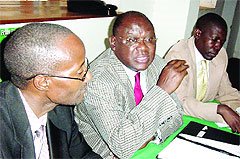
PRESS RELEASE
The Democratic Party, after reviewing (a) its mostly painful experiences over the last 50 years, (b) the mostly turbulent post independence history of Uganda and other Sub-Saharan African countries and the causes thereof, and (c) the prevailing political and economic global situation, has re-codified its guiding principles over the next 10 years and beyond and would like to inform its membership and the general public as follows:
DP Core Values: The DP core values are:
· Truth and Justice
· Peace, Security and Stability
· Honest Government
· Equal Opportunity for Social and Economic Advancement
· Equality Before the Law
· Observance of Basic Human Rights
2. DP’s Ideology:
We believe in a pluralistic democratic society in which every citizen has an unalienable right to exploit his/her potential for the purpose of improving his/her wellbeing without infringing on the rights of other citizens. We also believe in a system of government, pursuing a mixed economy policy which guarantees meaningful livelihoods for all.
3. DP’s Vision of the Nation-state of Uganda:
A nation of responsible citizens who are politically and economically empowered, productive, prosperous, united by the love of their country, and living in harmony with one another, the rest of humanity, and with their environment.
4. DP’s Vision of Itself:
A strong, united, and disciplined party championing personal, cultural and political freedoms of all citizens of Uganda, the rule of law, high ethical standards in Government, security of life and property and justice for all.
5. DP’s Mission:
To lawfully capture state power and form an efficient, effective, transparent and just government which will ensure the rule of law, peace, security, stability and prosperity for all citizens of Uganda and which will forge harmonious relations with all nations of the world.
6. DP’s Symbols:
Symbols are important for political and non-political organizations and among literate and illiterate societies because they convey important messages to stakeholders and clients in a concise and crisp manner. They brand organizations. The founders of DP chose a hand hoe as its symbol because it was the commonest and most important tool in the lives of Ugandans. It was the basis of all livelihoods at that time. Despite the passage of time, the hoe is still the primary tool of all rural people who comprise more than 90 percent of all Ugandans. The other 10 percent depend on the food produced by peasants using the hoe. Properly articulated this symbol can carry a very powerful political message. Therefore DP is retaining the hand hoe as the party’s main symbol.
Implications of the DP’s Guiding Principles:
These re-formatted principles of the party, have important implications for DP’s membership, on the relationship between DP and other political organizations in Uganda, and for the relationships between DP and political organizations outside Uganda.
Ø On DP Membership: All members of the party are expected to embrace these principles and all DP leaders are expected to articulate and propagate these, and not any other principles, when speaking on behalf of the party. Any present DP member who cannot and will not subscribe to these principles, has a fundamental right and honorable duty to leave the party.
Ø For other political organizations in Uganda: All political parties in Uganda registered separately under the Political Organizations Act. Other parties may not have been aware of our political principles at the time of their registration. We are hereby making these principles abundantly clear to all. Other parties or their members are free to join us if they subscribe to the same principles. If those parties do not subscribe to the same principles as DP, then they are clearly very different political entities. Because we believe in a pluralistic society, we will respect their separate and independent existence. We will however also expect other parties to respect DP’s separate and independent existence.
Ø For External Organizations: In global terms, the principles enumerated above place DP in a centrist position. Historically, DP has never been a fascist or right wing party and neither is it contemplating to be so. Similarly, DP has never been a socialist or left wing party and neither is it planning to be so. DP abhors extremism. The party will therefore associate with political organizations in the international arena which share its political ideals. For now, DP is opting to associate with conservative organizations.
In Truth and Justice and For God and my Country
Joseph K Mukiibi PhD
DP NATIONAL CHAIRMAN
For and on behalf of DP National Executive Committee
11th July 2006
CC: President-General of DP
CC: All members of NEC

PRESS RELEASE
The Democratic Party, after reviewing (a) its mostly painful experiences over the last 50 years, (b) the mostly turbulent post independence history of Uganda and other Sub-Saharan African countries and the causes thereof, and (c) the prevailing political and economic global situation, has re-codified its guiding principles over the next 10 years and beyond and would like to inform its membership and the general public as follows:
DP Core Values: The DP core values are:
· Truth and Justice
· Peace, Security and Stability
· Honest Government
· Equal Opportunity for Social and Economic Advancement
· Equality Before the Law
· Observance of Basic Human Rights
2. DP’s Ideology:
We believe in a pluralistic democratic society in which every citizen has an unalienable right to exploit his/her potential for the purpose of improving his/her wellbeing without infringing on the rights of other citizens. We also believe in a system of government, pursuing a mixed economy policy which guarantees meaningful livelihoods for all.
3. DP’s Vision of the Nation-state of Uganda:
A nation of responsible citizens who are politically and economically empowered, productive, prosperous, united by the love of their country, and living in harmony with one another, the rest of humanity, and with their environment.
4. DP’s Vision of Itself:
A strong, united, and disciplined party championing personal, cultural and political freedoms of all citizens of Uganda, the rule of law, high ethical standards in Government, security of life and property and justice for all.
5. DP’s Mission:
To lawfully capture state power and form an efficient, effective, transparent and just government which will ensure the rule of law, peace, security, stability and prosperity for all citizens of Uganda and which will forge harmonious relations with all nations of the world.
6. DP’s Symbols:
Symbols are important for political and non-political organizations and among literate and illiterate societies because they convey important messages to stakeholders and clients in a concise and crisp manner. They brand organizations. The founders of DP chose a hand hoe as its symbol because it was the commonest and most important tool in the lives of Ugandans. It was the basis of all livelihoods at that time. Despite the passage of time, the hoe is still the primary tool of all rural people who comprise more than 90 percent of all Ugandans. The other 10 percent depend on the food produced by peasants using the hoe. Properly articulated this symbol can carry a very powerful political message. Therefore DP is retaining the hand hoe as the party’s main symbol.
Implications of the DP’s Guiding Principles:
These re-formatted principles of the party, have important implications for DP’s membership, on the relationship between DP and other political organizations in Uganda, and for the relationships between DP and political organizations outside Uganda.
Ø On DP Membership: All members of the party are expected to embrace these principles and all DP leaders are expected to articulate and propagate these, and not any other principles, when speaking on behalf of the party. Any present DP member who cannot and will not subscribe to these principles, has a fundamental right and honorable duty to leave the party.
Ø For other political organizations in Uganda: All political parties in Uganda registered separately under the Political Organizations Act. Other parties may not have been aware of our political principles at the time of their registration. We are hereby making these principles abundantly clear to all. Other parties or their members are free to join us if they subscribe to the same principles. If those parties do not subscribe to the same principles as DP, then they are clearly very different political entities. Because we believe in a pluralistic society, we will respect their separate and independent existence. We will however also expect other parties to respect DP’s separate and independent existence.
Ø For External Organizations: In global terms, the principles enumerated above place DP in a centrist position. Historically, DP has never been a fascist or right wing party and neither is it contemplating to be so. Similarly, DP has never been a socialist or left wing party and neither is it planning to be so. DP abhors extremism. The party will therefore associate with political organizations in the international arena which share its political ideals. For now, DP is opting to associate with conservative organizations.
In Truth and Justice and For God and my Country
Joseph K Mukiibi PhD
DP NATIONAL CHAIRMAN
For and on behalf of DP National Executive Committee
11th July 2006
CC: President-General of DP
CC: All members of NEC
Wednesday, July 05, 2006
Reopen Federalism Debate

Government has failed to implement the Regional Tier by the July 1, 2006 constitutional deadline. Government cash strapped after the February 2006 elections cannot afford to hold another round of elections. The regional governments' mandate over natural resources may also be problematic creating a new headache for the central government after discovery of oil in Lake Albert. Land ownership remains a very sensitive issue in Uganda which is in the middle of a prolonged population boom rising from 16 million residents in 1991 to nearly 30 million people in 2006. The excuse given by Third Deputy Prime Minister Ally Kirunda Kivejjinja that Buganda the biggest proponent for regional government refused to cooperate with government to implement the regional tier does not ring true for the other regional governments; Acholi, Busoga, Bunyoro which have even more significant regional issues.
Otafiire pays tribute to DP President
Local Government Minister Kahinda Otafiire has commended the work of former Kampala Mayor and DP President Sebaana Kizito in redeveloping Kampala City. Otafiire made the remarks while presiding over the Association of Local Government Authorities Assembly in Masaka over the weekend. According to the state owned media, Otafiire said that "deep down in me" , "I Knew Sebaana did a good job".
Thursday, June 15, 2006
DP Officials prepare for Official Budget Response
Top DP officials SG Richard Ottoo and Treasurer Hajati Sarah Sebaggala are on their way to Parliament to listen to the Budget Speech. Their official response is expected later this week. Finance Minister Dr. Suruma is expected to present an austerity budget occasioned by the Energy crisis and worsening balance of payments situation caused by an astronomical energy bill. DP has been very critical of the statist approach of subsidizing a few large businesses at the expense of the vast micro-finance sector now overseen by President Museveni's half brother Caleb Akandwanaho.
DP NEC Debates Shadow Cabinet
DP's National Executive Committee heard presentations from DP MPs who want to be included in FDC's shadow cabinet. This follows a series of contradictory messages from the Parliamentary group who have been lobbying hard to be included in FDC's Official Parliamentary grouping. In the 9th Parliament, the Official Opposition controls 4 Parliamentary Committees out of 18. More than ten weeks after Parliament's inauguration, the official opposition has failed to name a Shadow Cabinet and operationalize its whip. DP was the first parliamentary party to name its Shadow Cabinet followed by NRMO and UPC.
Thursday, May 25, 2006
Shadow DP Health Minister praises sacking of Health Bosses
In his first official briefing as Shadow DP Minister for Health and Human Services, Dr. Bayigga Lulume has commended the sacking of Health Ministers, Jim Muhwezi, Dr. Robert Kamugisha (Primary Health Care) and Capt. Mike Mukula (General Duties). Dr. Bayigga noted that their testimony at the GF Inquiry showed how detached the ministerial team was from the welfare of the common man, an environment that encouraged plunder of GF funds. All 3 were at the center of the controversial Global Fund scandal that misappropriated more than $200 million. General Muhwezi, a long time protege of President Museveni who took some directives from the President and his wife, Ruhama MP Janet Museveni was promised a new posting if the Global Fund report now being drafted absolved him of blame. Rukungiri district home to both Muhwezi and FDC President Kizza Besigye has another MP Paula Turyahikayo (Rubabo) on the list of those likely to be recommended for prosecution. Cpt Mukula is being lined up for posting as High Commissioner to the UK according to the Uganda Weekly Observer, while Dr. Kamugisha a former CA candidate (Rujumbura) (1994) and former High Commissioner to Kenya is retiring from active politics.
DP USA Annual meeting kicks on Dallas, TX
The annual DP USA summer meeting kicks off Saturday in Dallas TX. Members are being hosted by DP Texas Chairman, Sebastian Lwanga. Party business includes a confidential working paper sent by DP President General Sebaana Kizito. The party rejuvenation program has evolved into working papers prepared by different working groups. DP Texas is the second largest DP branch in the United States, behind California.
Masaka by-election today

Voters in Masaka district elect a Woman District MP. Agnes Mayanja is carrying the flag for the Democratic Party. DP MPs led by Matia Nsubuga Bireke descended into Uganda's former breadbasket to canvass for Agnes Mayanja.
Wednesday, May 10, 2006
DP Shadow Cabinet
President: John Sebaana Kizito
Vice President and Minister of Education:Rainer Kafire
International & Regional Affairs: Dr. Richard Ebil Ottoo
Finance, Planning & Econ Dev: Sarah Kanyike Ssebaggala
National Security and Resettlement: Norbert Mao
Trade, Industry and Tourism: Issa Kikungwe
Local Government: Besweri Kezaala
Lands, Water & Environment: Mathias Nsubuga
Internal Affairs: John Kawanga
Health: Dr. Bayigga Lulume
Cooperatives & Rural Development: Deo Hasubi Njoki
Agriculture, Animal Industry & Fisheries: Prof. Joseph Mukiibi
Works & Transport: John Mugisha
Information: Betty Nambooze
Housing: Fred Mwesigwa
Legal Affairs: Erias Lukwago
Energy: Sebuliba Mutumba
Other appointments:
Jude Mbabaali: Personal Assistant to DP President.
Vice President and Minister of Education:Rainer Kafire
International & Regional Affairs: Dr. Richard Ebil Ottoo
Finance, Planning & Econ Dev: Sarah Kanyike Ssebaggala
National Security and Resettlement: Norbert Mao
Trade, Industry and Tourism: Issa Kikungwe
Local Government: Besweri Kezaala
Lands, Water & Environment: Mathias Nsubuga
Internal Affairs: John Kawanga
Health: Dr. Bayigga Lulume
Cooperatives & Rural Development: Deo Hasubi Njoki
Agriculture, Animal Industry & Fisheries: Prof. Joseph Mukiibi
Works & Transport: John Mugisha
Information: Betty Nambooze
Housing: Fred Mwesigwa
Legal Affairs: Erias Lukwago
Energy: Sebuliba Mutumba
Other appointments:
Jude Mbabaali: Personal Assistant to DP President.
Monday, April 24, 2006
DP Lays Strategy for Poll Security in 2011
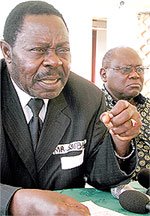
In a move directly aimed at addressing rigging machinations and politicians playing upon voter's fear of violence, DP announced bold moves to equip itself with poll security ahead of the 2011 elections. At the end of a two day retreat that brought together warring factions, local and international leaders, DP's leaders summarized proposals to tackle burning issues in the party. A strong statement announcing training of party vigilantes provoked strong reaction from all corners of the political divide. These reactions forgot to note that DP's approach would remain lawful with the sole purpose of enforcing the laws on the books rather than a wholesale declaration of war on the government. Pictured left DP President Sebaana Kizito and DP National Chairman Prof. Joseph Mukiibi.
Sunday, April 16, 2006
DP President hosted by DP London Branch

DP President Sebaana Kizito returned home last week after a working visit to the United Kingdom. Completing his visit, he was hosted by the DP UK London branch where he briefed them on the last general elections and DP affairs in general. Addressing the disappointment with the poll results, President Sebaana Kizito pointed out that the final results did not reflect underlying DP support and its resurgence at the grassroots that benefited from his national campaign. In the last election DP candidates managed to collect 19% of all votes cast in parliamentary races yet they put up candidates in only 68 constituencies. It may be on of the bases for revitalizing proposals to switch to proportional representation in Parliament now that Uganda has entrenched a direct presidential election model.
Masaka Woman MP Agnes Mayanja faces by-election
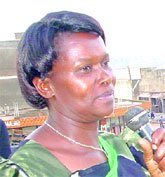
Agnes Mayanja's election to Parliament unopposed was struck down by High Court Judge Richard Oscar Okumu Wengi, in favor of Sauda Namaggwa Mugerwa, a former diplomat. Mrs. Mugerwa completing her first term failed to submit her academic testimonials in time to the Electoral Commission a requirement for parliamentary nomination. The circumstances of this ruling are still being studied.
Thursday, April 06, 2006
DP leaders in London for talks with Conservative Party
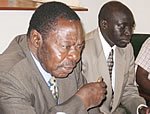
DP President John Sebaana Kizito and DP Secretary General Richard Ottoo are in London for talks with the Conservative Party. John Sebaana Kizito arrived in London enroute from Madrid where he attended a World Mayor's Conference.
Thursday, March 30, 2006
DP Plans Post-election retreat

DP members plans to head into retreat April 20-23, 2006 to discuss the implications of the 2006 elections. The retreat will be at Ranch on the Lake in Entebbe. Picture left, DP PG and SG, Dr. Richard Ottoo addressing a press conference in Kampala today.
Monday, March 06, 2006
DP wins Masaka and Jinja Municipality seats, falls in Gulu
Elections for Mayor in Uganda's 14 municipalities ended yesterday. DP's incumbent Alex Ojera lost in Gulu Municipality. DP Vice Chair Besweri Kezaala swept aside the incumbent Wakudumira in Jinja by a 2:1 margin while Masaka Municipality Mayor John Tebyasa was slightly ahead of the NRM candidate in early returns filed with the local press Monday night.
Sunday, March 05, 2006
Election Petitions reveal quandary of irregularities
Uganda's 2006 elections are being lauded as a watershed in terms of the freedom that accompanied the polling. Not so fast, the semblance of normalcy is quickly being thrown into challenge by election petitioners. So far, the biggest headache for candidates and their agents is the wide latitude given to the Returning Officer to announce election results. The Returning Officers' announcement ends all challenges to the counting process throwing it to the courts. Several Chief Administrative Officers (CAOs) appointed as returning officers used this power to frustrate candidates and their agents before declaring a winner. Since the Returning Officer collects results from field agents who include polling assistants and assistant returning officers, the integrity of the process is supposed to be checked by candidates' agents signature and countermanding of the tally sheets used to prepare an official Declaration of Results.
Norbert Mao wins Gulu LC V Chair
Outgoing Gulu Municipality MP won the Gulu district LC V seat polling 77.7% of the vote. He defeated Col. Walter Ochora who has served for 2 terms. Col. Ochora is remembered for the Radio Uganda announcement that ended Milton Obote's second presidency on July 28, 1985. Mao relinquishes Chairmanship of the DP Parliamentary caucus, will live and work in Gulu full-time.
Subscribe to:
Posts (Atom)


